
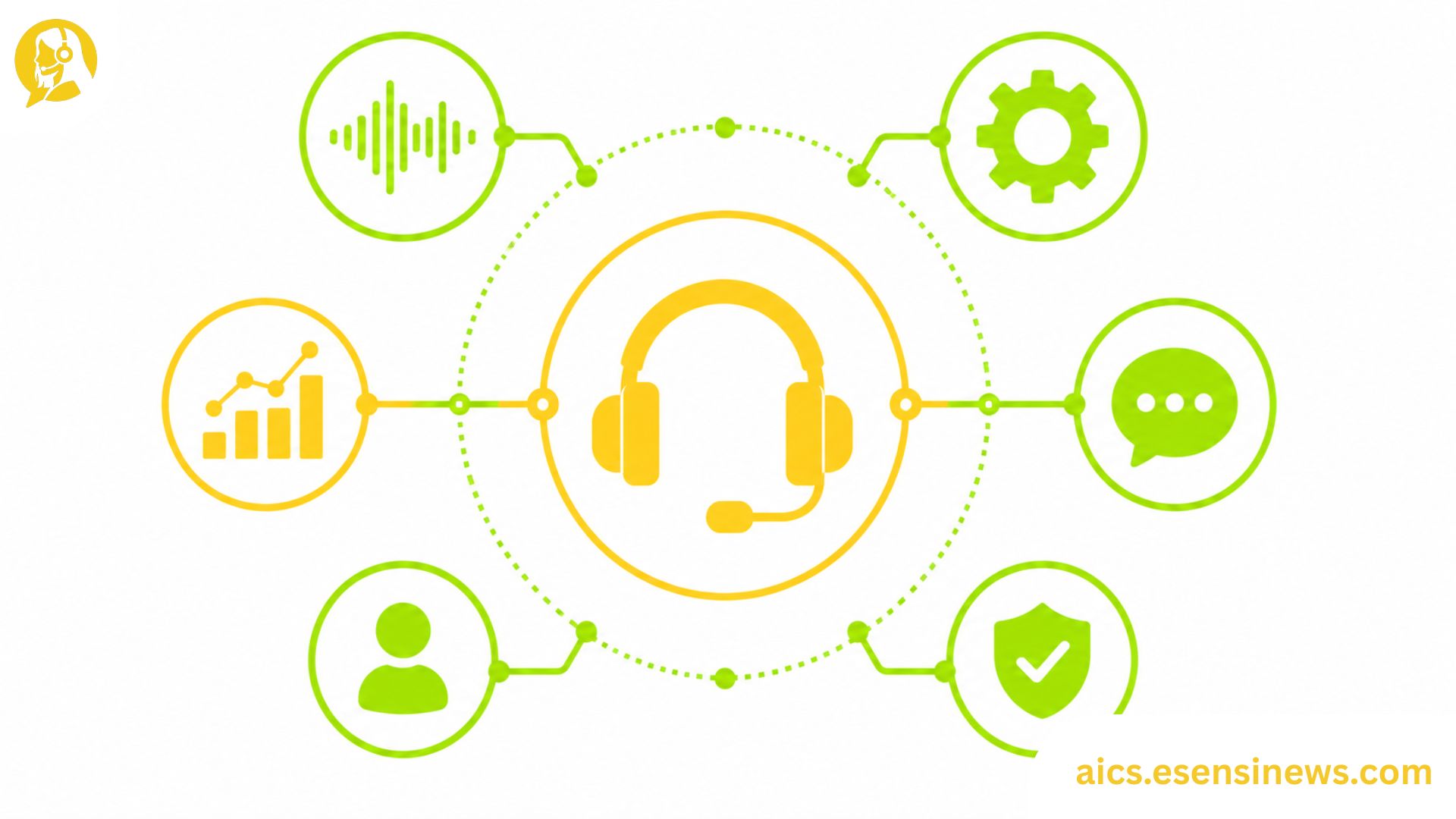
Contact center AI has moved from “something worth exploring” to “something your competitors are already using.” If you’re running a contact center today and haven’t started thinking seriously about AI, you’re probably already feeling the pressure: rising call volumes, tighter budgets, customers who expect faster responses, and agents who are burning out on repetitive work. That combination is exactly what makes contact center AI worth understanding properly.
But “contact center AI” covers a lot of ground. It can mean smart IVR systems, real-time transcription, sentiment analysis, workforce forecasting, or autonomous voice agents, often all at once. For operations leaders who need to make real decisions about where to start, what to invest in, and how to roll it out, a clear overview is more useful than a features checklist.
This guide covers what contact center AI actually is, the main categories worth knowing, the benefits and trade-offs to plan for, and a practical starting point for any operations leader ready to move from thinking about AI to actually building it into their floor.
What Is Contact Center AI?
Contact center AI refers to artificial intelligence systems designed specifically for the demands of high-volume, often voice-based customer support environments. This includes technology that handles customer interactions directly, as well as tools that work behind the scenes to support agents, supervisors, and workforce managers.
Unlike general-purpose AI tools, contact center AI has to handle the specific challenges of real-time voice processing, high emotional variability, compliance requirements, and the pressure of call queues that don’t slow down for technical difficulties.
The Main Categories of Contact Center AI
1. Conversational AI and Voice Bots
Systems that understand natural spoken language and can handle customer calls end-to-end for routine requests, or gather context before passing to a human agent. Modern voice bots go significantly beyond old-style IVR menus, handling intent-based routing rather than button presses.
2. Real-Time Agent Assist
AI that works alongside human agents during live interactions, suggesting responses, surfacing relevant knowledge base content, or flagging emotional cues in real time. The agent stays in control, with AI acting as a smart support layer.
3. Call Transcription and Analytics
Automatic transcription of calls for documentation, quality review, and compliance. Analytics tools built on this data can identify trends, recurring issues, and coaching opportunities at a scale that manual review can’t match.
4. Sentiment and Escalation Detection
AI that monitors tone, pacing, and word choice during calls to detect rising frustration and flag conversations for supervisor attention or faster escalation before they deteriorate further.
5. Workforce Management and Forecasting
AI models that analyze historical call patterns to predict volume, optimize scheduling, and improve staffing decisions across shifts and seasons.
6. Quality Assurance and Coaching
AI that automatically scores calls against quality criteria, providing supervisors with structured, data-driven coaching opportunities across a much larger sample than traditional QA processes allow.
What Contact Center AI Actually Changes on the Floor
When contact center AI is implemented thoughtfully, the operational impact tends to show up in a few consistent ways:
- Agents handle fewer repetitive calls, spending more time on complex and emotionally nuanced interactions
- Supervisors shift from reactive monitoring to proactive coaching, guided by AI-generated insights
- Staffing decisions become more accurate, as AI forecasting reduces both overstaffing and understaffing
- Quality coverage expands dramatically, since AI can review far more interactions than human analysts can manually
- New roles emerge, including conversation designers, AI performance analysts, and adoption managers
Key Metrics That Contact Center AI Can Move
Operations leaders should track these metrics before and after implementation to measure real impact:
- Average Handle Time (AHT) — Does AI reduce time per interaction for routine calls?
- First Call Resolution (FCR) — Does smarter routing and agent assist improve one-call resolution?
- Average Speed of Answer (ASA) — Does self-service AI reduce hold times?
- Occupancy Rate — Does better forecasting improve workload balance?
- CSAT and CES — Does AI actually improve customer satisfaction and reduce effort?
- Agent Attrition — Does reducing repetitive load improve retention over time?
Benefits and Trade-Offs of Contact Center AI
Benefits ✅
- Handles high call volume more efficiently without proportional cost increases
- Reduces repetitive agent workload, improving engagement and reducing burnout
- Provides 24/7 coverage for routine requests without overnight staffing
- Generates richer operational data for smarter decisions at every level
- Improves quality coverage across more interactions than manual review allows
Trade-Offs ❌
- Voice AI accuracy varies with accents, audio quality, and off-script conversations
- Implementation takes real time, especially with legacy telephony systems
- Ongoing maintenance is required as call patterns and policies evolve
- Workforce transition needs planning, since roles shift meaningfully when AI is live
- Risk of over-automation before trust and accuracy are fully established
Where to Start With Contact Center AI
For operations leaders approaching this for the first time, these five steps tend to produce better outcomes than jumping straight to vendor selection.
- Audit your current call mix. Identify which call types are highest volume and lowest complexity — these are your best AI candidates.
- Set baseline metrics. Document AHT, FCR, ASA, and CSAT now, so you have a clear before state to measure against later.
- Decide which category to start with. Agent assist and QA automation tend to be lower-risk starting points than full voice bot deployment for most teams.
- Build your workforce transition plan alongside your tech plan. Agents need to understand what changes before it changes.
- Pilot with a single queue or shift. Generate real data before scaling, rather than committing to full deployment based on vendor demos.
Common Mistakes Operations Leaders Make With Contact Center AI
- Starting with the most advanced technology rather than the highest-impact, lowest-risk entry point
- Skipping workforce planning, leading to confusion and resistance on the floor when AI goes live
- Failing to set baseline metrics, making it impossible to demonstrate real impact to leadership
- Treating AI as a one-time project rather than an ongoing operational responsibility
- Choosing vendors based on demos without testing with real, unpredictable call data
FAQ: Contact Center AI
1. What is contact center AI? Contact center AI refers to artificial intelligence systems built for high-volume support environments, covering voice bots, agent assist, transcription, sentiment detection, workforce forecasting, and quality assurance.
2. What’s the easiest way to start with contact center AI? Agent assist tools or QA automation tend to be lower-risk starting points than full voice bot deployment, since they support human agents rather than replacing them.
3. How does contact center AI affect agent jobs? Routine, repetitive tasks move to AI, while human agents increasingly handle complex, judgment-heavy interactions. New roles also emerge around AI management and performance.
4. What metrics should I track when implementing contact center AI? Focus on AHT, FCR, ASA, occupancy rate, CSAT, and agent attrition to measure real operational impact before and after implementation.
5. Is contact center AI reliable enough for voice interactions? Modern voice AI is genuinely capable for routine requests, though accuracy still varies with accents, audio quality, and off-script conversations, so human escalation paths remain essential.
6. How long does it take to implement contact center AI? A focused pilot can often launch within a few weeks, though broader deployment and fine-tuning across multiple queues typically takes several months.
7. How do I get agent buy-in for contact center AI? Involve agents early, communicate clearly about what changes and what doesn’t, and update performance metrics to reflect the new working environment before AI goes live.
Conclusion
Contact center AI isn’t a single decision, it’s a series of connected ones about which technologies to adopt, in what order, and how to bring your team along for the change. The operations leaders who navigate this well tend to start with a clear audit of their call mix, set measurable baselines, plan the workforce transition early, and pilot before scaling. That’s how contact center AI becomes a durable operational advantage rather than a frustrating experiment.
The takeaway? Don’t chase the most sophisticated AI features right away. Start where AI has the clearest, most measurable impact for your specific floor — and build from there.
Ready to Build Your Contact Center AI Strategy?
If this guide gave you a clearer starting point, spend some time auditing your call mix this week and identify your top two or three AI candidate call types. Know another ops leader exploring contact center AI for the first time? Share this with them. And if you’re planning to go deeper on any specific area, whether that’s voice bots, workforce planning, or compliance, bookmark this page as your starting point. Here’s to an AI strategy built on solid ground, not just good intentions.


Leave a Reply