
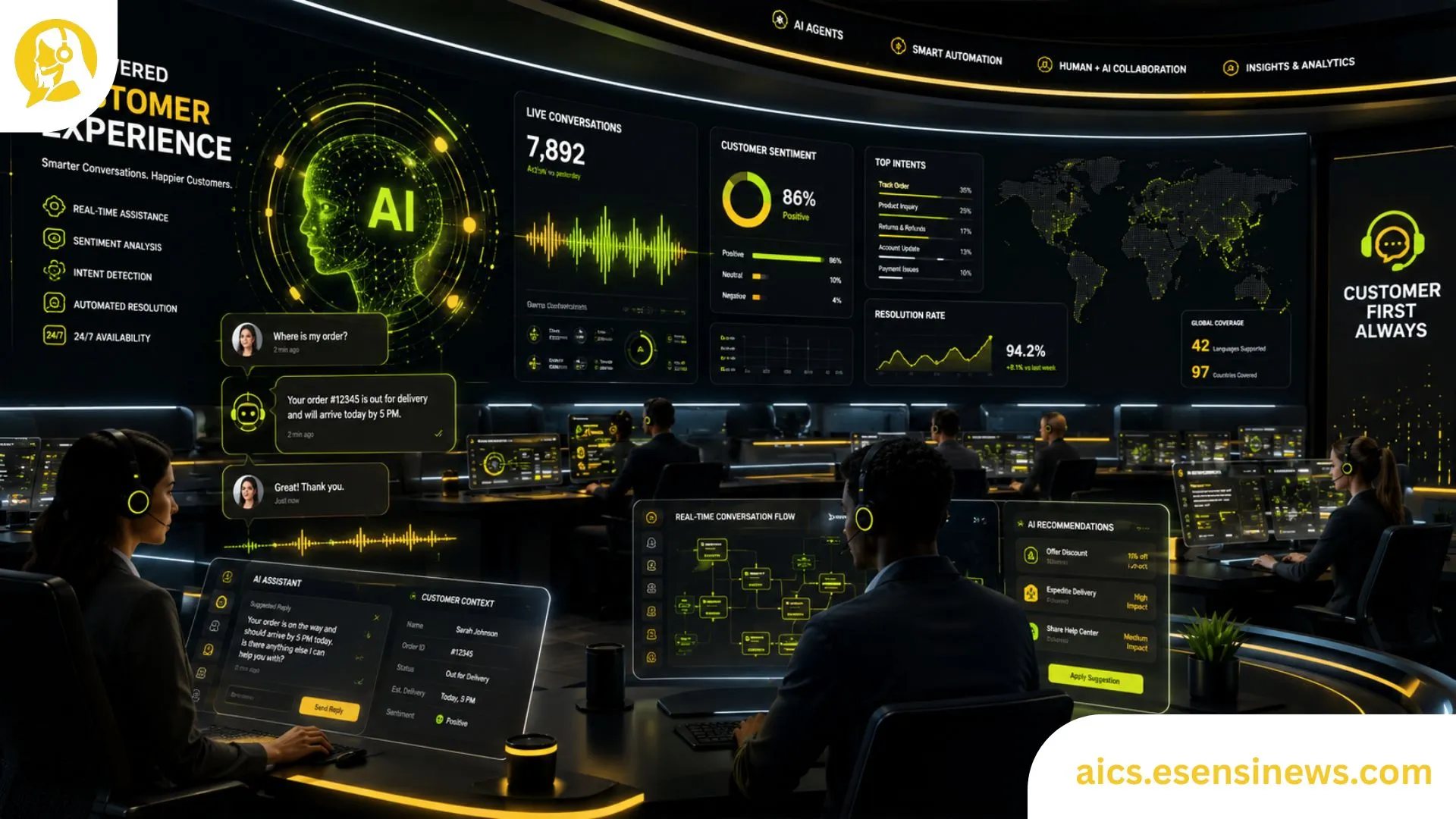
Unlock the future of customer service with AI contact centers, where efficiency meets personalization, transforming every interaction into an exceptional experience. If you’ve ever been stuck on hold for 30 minutes only to get transferred three times before reaching the right person yeah, that pain is real. The good news? That scenario is becoming a relic of the past. AI contact centers are rewriting the rules of customer engagement, and the shift is happening faster than most businesses realize.
I’ve spent years studying how enterprise customer service teams operate, and real talk the gap between companies using AI-driven support and those still running manual queues is widening fast. This isn’t hype. The data backs it up, the ROI is measurable, and the customer satisfaction scores speak for themselves.
Understanding AI in Customer Service
Before we get into the benefits, let’s get clear on what an ai contact center actually is because it’s more than just a chatbot answering FAQs.
An AI contact center is a modern customer service infrastructure that uses artificial intelligence, machine learning, and natural language processing (NLP) to handle, route, analyze, and improve customer interactions across every channel voice, chat, email, social media, and SMS. Think of it like upgrading from a manual switchboard to a fully automated, self-learning communication hub.
How AI Differs from Traditional Call Centers
Traditional call centers operate on simple if-then logic: caller presses 1 for billing, 2 for support. Agents follow scripts. Supervisors manually review call recordings. The whole process is reactive.
AI contact centers flip that model. They’re proactive, predictive, and personalized. The system learns from every interaction, anticipates what a customer needs before they ask, and routes them to the right resource human or automated in seconds. It’s the difference between a flip phone and a smartphone. Same basic function, completely different experience.
| Feature | Traditional Call Center | AI Contact Center |
|---|---|---|
| Call Routing | IVR menu-based | Intelligent intent detection |
| Availability | Business hours only | 24/7/365 |
| Agent Support | Manual scripts | Real-time AI suggestions |
| Analytics | Post-call reports | Live sentiment analysis |
| Scalability | Hire more agents | Instant AI scale-up |
| Cost per Contact | $6–$12 (industry avg.) | $0.50–$2.00 with AI assist |
The numbers in that table? Those are conservative estimates based on industry benchmarks from Gartner and McKinsey research from 2023–2024. Your mileage may vary, but directionally the cost story is compelling.
Key Benefits of AI Contact Centers
Let’s spill the real value here. Companies don’t invest in AI contact center platforms just because it sounds cool. They do it because the ROI is measurable and often shows up within the first 6–12 months of deployment.
Faster Resolution Times
According to IBM’s 2024 Customer Experience Report, AI-powered contact centers resolve customer issues 40% faster on average compared to traditional setups. That’s not a marginal improvement that’s transformational. When a customer calls about a billing dispute at 11 PM, they don’t want to wait until 9 AM when agents clock in. An AI agent handles it instantly.
24/7 Availability Without the Overtime Bill
Staffing a contact center round-the-clock means shifts, benefits, training costs, and high turnover. The global average call center agent turnover rate hovers around 30–45% annually a brutal statistic. AI doesn’t quit, doesn’t call in sick, and doesn’t need a lunch break.
Consistent Quality at Scale
Human agents have good days and bad days. Menurut gue, that’s just reality no shade to agents. But AI maintains the same tone, accuracy, and compliance adherence on call #1 and call #10,000. For regulated industries like healthcare, finance, and insurance, that consistency is non-negotiable.
Omnichannel Fluidity
A customer starts a chat on your website, continues via WhatsApp, then calls in. Without AI, those three interactions are siloed. With an AI contact center, the full conversation history travels with the customer. No repetition. No frustration. Just continuity.
Enhanced Customer Experience through AI
Here’s where things get genuinely interesting. The CX improvements from ai contact center technology aren’t just about speed they’re about depth of understanding.
Personalization at Scale
AI systems pull from CRM data, purchase history, previous support tickets, and real-time behavioral signals to personalize every interaction. Imagine calling a company and the AI already knows you’ve been a customer for 8 years, your last order had a shipping delay, and you’ve contacted support twice this month. That context changes the entire conversation.
Salesforce’s State of the Connected Customer report (2024) found that 73% of customers expect companies to understand their unique needs and expectations. AI makes that possible without drowning your agents in data entry.
Emotional Intelligence and Sentiment Analysis
Modern AI contact centers don’t just parse words they analyze tone, pace, and language patterns to detect frustration, urgency, or confusion in real time. If a customer’s sentiment shifts negative mid-conversation, the system can automatically flag it for human escalation or adjust its own response style to de-escalate.
“Sentiment-aware AI support reduced our escalations by 28% in Q3 2024, which directly improved our CSAT scores by 15 points.” Director of CX Operations, mid-market SaaS company (via Forrester case study)
Reduced Wait Times = Happier Customers
A 2024 Zendesk benchmark report showed that customers abandon support queues after waiting an average of 11 minutes. AI deflection where bots handle common queries before they reach human agents can reduce queue wait times by 60–70% for high-volume contact centers.
Cost Efficiency and Resource Optimization
Real talk if you’re pitching an AI contact center upgrade to your CFO, this section is your best friend.
The True Cost of Human-Only Operations
When you factor in recruitment, training (typically 4–6 weeks for a new agent), salary, benefits, workspace, and software licenses, a single full-time contact center agent in the US costs approximately $35,000–$55,000 per year. For a 100-seat center, that’s $3.5M–$5.5M annually before you factor in management overhead.
AI Cost Structure: What You’re Actually Paying
Most enterprise AI contact center platforms operate on a per-interaction or subscription model. Here’s a realistic breakdown:
| Platform Tier | Monthly Cost | Included Interactions | Cost per Add’l Interaction |
|---|---|---|---|
| SMB / Starter | $500–$2,000 | Up to 5,000 | $0.08–$0.15 |
| Mid-Market | $3,000–$8,000 | Up to 25,000 | $0.05–$0.10 |
| Enterprise | $10,000–$50,000+ | Custom volume | Negotiated |
| Voice AI Add-on | +$1,500–$5,000/mo | Varies | $0.10–$0.25/min |
Prices reflect 2024–2025 market averages across vendors including Five9, NICE CXone, Genesys Cloud, and Salesforce Service Cloud Voice.
Buying Guide: What to Budget For
If you’re evaluating an AI contact center solution for your business, here’s what to budget beyond the license fee:
- Integration costs: $5,000–$30,000 one-time (CRM, ticketing systems, telephony)
- Training & onboarding: 4–8 weeks, often covered by vendor in enterprise tiers
- Customization: NLP model tuning, custom intents $2,000–$15,000 depending on complexity
- Ongoing maintenance: 10–15% of annual license cost for updates and optimization
Is it worth it? My experience yes, for any contact center handling more than 500 interactions per month. Below that threshold, ROI takes longer to materialize.
AI-Powered Analytics for Better Decision Making
Here’s a benefit that often gets undersold in the excitement over automation: AI contact centers generate intelligence that traditional systems simply can’t produce.
From Data to Decisions
Every conversation in an AI contact center is captured, transcribed, analyzed, and categorized automatically. Instead of a QA manager manually listening to 50 random calls per week, the AI analyzes 100% of interactions and surfaces patterns:
- Top reasons for contact (by volume and by cost-to-serve)
- First contact resolution (FCR) rates by topic, channel, and agent
- Customer satisfaction trends correlated with specific agent behaviors
- Product or service issues triggering spikes in contact volume
Predictive Analytics: Knowing What’s Coming
Advanced platforms use historical data to predict future contact volume, enabling proactive staffing and resource allocation. During a product launch or known seasonal spike, the system can alert managers 2–3 weeks ahead: “Expect a 35% increase in billing inquiries the first week of November based on the last 3 years of data.”
That kind of foresight is genuinely game-changing for operations planning.
Real-Time Agent Coaching
AI doesn’t just analyze after the fact. During live calls, some platforms surface contextual suggestions to agents: “Customer mentioned competitor pricing suggest our loyalty discount.” or “Detect compliance trigger recommend escalating to supervisor.” It’s like having a coach whispering in your ear the whole time, except it’s not creepy because it’s helpful.
Integration with Existing Customer Service Systems
One of the most common concerns I hear from ops and IT teams: “Will this actually work with our existing stack?”
Valid concern. The good news is that mature AI contact center platforms are built for integration. Most offer pre-built connectors for:
- CRM platforms: Salesforce, HubSpot, Microsoft Dynamics, Zoho
- Ticketing systems: Zendesk, ServiceNow, Freshdesk, Jira Service Desk
- Communication platforms: Twilio, Avaya, Cisco, RingCentral
- Business intelligence: Tableau, Power BI, Google Looker
API-First Architecture
Modern AI contact center vendors follow API-first design, meaning even if a pre-built connector doesn’t exist for your specific tool, a custom integration is typically achievable within weeks rather than months. REST APIs and webhooks are standard.
Data Unification Challenges
That said real talk data silos are still a genuine integration challenge. If your CRM data is messy, incomplete, or stored across three different systems, the AI’s personalization capability is limited by the quality of input data. Garbage in, garbage out. Before implementation, a data audit is non-negotiable.
Challenges and Considerations for Implementation
Okay, gue nggak mau jadi artikel yang cuma ngomong bagusnya aja. Let’s talk about the real challenges.
✅ Pros of AI Contact Centers
- ✅ Dramatic reduction in cost-per-contact (often 60–70% lower)
- ✅ 24/7 availability without staffing costs
- ✅ Consistent quality and compliance adherence
- ✅ Rich analytics and actionable intelligence
- ✅ Faster resolution for common, high-volume issues
- ✅ Scalable without proportional headcount increase
- ✅ Omnichannel context preservation
❌ Cons and Honest Limitations
- ❌ High upfront investment in integration and customization
- ❌ Complex or emotionally sensitive issues still need human agents
- ❌ AI can misinterpret ambiguous language or heavy accents
- ❌ Customer resistance some demographics strongly prefer human agents
- ❌ Data privacy risks if customer data is used to train third-party AI models
- ❌ Ongoing maintenance and retraining as products/policies change
- ❌ Risk of “bot fatigue” if the AI experience is poorly designed
Change Management: The Human Side
The biggest implementation risk isn’t technical it’s cultural. Agents fear job loss. Managers resist change. Leadership underestimates the training required. Companies that rush deployment without proper change management often end up with expensive tools that nobody trusts or uses effectively.
The best implementations I’ve seen treat AI as agent augmentation, not agent replacement. Frame it to your team as “AI handles the repetitive stuff so you can focus on the interesting problems.” That framing actually tends to be accurate, not just PR spin.
Future Trends in AI Contact Centers
Where is this all headed? For me personally, the next 3–5 years are going to be wild in this space.
Generative AI Integration
Post-2023, generative AI (think large language models similar to what powers modern assistants) is being embedded directly into contact center workflows. This enables AI agents to draft personalized email responses, summarize long case histories, generate dynamic scripts, and even negotiate simple resolutions within policy boundaries autonomously.
Gartner predicts that by 2026, 80% of customer service organizations will be using generative AI to improve agent productivity and customer experience. That’s not a distant future it’s 18 months away.
Voice AI Maturity
Early voice bots were painful clunky, limited vocabulary, easy to break. The new generation of voice AI uses neural text-to-speech and real-time transcription that’s genuinely hard to distinguish from a human in a casual interaction. Expect voice AI to handle upward of 50% of inbound call volume at enterprise contact centers by 2027.
Hyper-Personalization via Behavioral AI
Beyond CRM data, AI is beginning to incorporate behavioral signals how fast someone types, how they navigate a help portal, what they clicked on before contacting support to create hyper-personalized service experiences. It’s a bit ibarat your coffee shop already knowing your order before you walk in the door.
Proactive Service Models
The future isn’t just reactive AI (responding to customer contacts) it’s proactive AI that detects potential issues before customers even notice. A SaaS platform detecting API latency issues might automatically notify affected users and open a support ticket before a single complaint is filed. That’s the direction high-maturity AI contact centers are heading.
Conclusion: Embracing AI for Superior Customer Service
If there’s one takeaway from everything above, it’s this: the question isn’t whether your organization should adopt an AI contact center it’s how fast and how thoughtfully you do it.
The benefits are real and measurable: lower costs, faster resolution, 24/7 coverage, deeper analytics, and when done right genuinely better customer experiences. The challenges are real too: integration complexity, change management, and the ongoing work of tuning AI systems to reflect your specific business context.
The companies winning at customer service right now aren’t the ones with the biggest teams. They’re the ones with the smartest infrastructure. AI contact centers are that infrastructure.
Ready to take the next step? Explore the latest AI contact center tools and strategies at aics.esensinews.com or dig deeper into platform comparisons and implementation guides at the AI Contact Center resource hub.
Last updated: June 2026
Frequently Asked Questions (FAQ)
1. What is an AI contact center and how does it differ from a regular call center?
An AI contact center integrates artificial intelligence including NLP, machine learning, and conversational AI into the entire customer service operation. Unlike a traditional call center that relies primarily on human agents following scripts, an AI contact center automates routine interactions, routes contacts intelligently based on intent, analyzes 100% of interactions for quality insights, and provides real-time support to human agents during live conversations. The result is faster resolution, lower cost-per-contact, and more consistent service quality.
2. How much does it cost to implement an AI contact center?
Costs vary widely based on scale. Smaller businesses might start at $500–$2,000/month for SMB-tier platforms. Mid-market implementations typically run $3,000–$8,000/month for the software, plus one-time integration costs of $5,000–$30,000. Enterprise deployments at high-volume contact centers can exceed $50,000/month but typically yield ROI within 12–18 months through reduced headcount and lower cost-per-interaction. Always request a detailed TCO (Total Cost of Ownership) analysis from vendors before committing.
3. Will AI contact centers replace human agents?
Not entirely and this is an important distinction. AI contact centers are best positioned to handle high-volume, repetitive, and transactional interactions (password resets, order status, basic FAQs). Complex issues, emotionally charged situations, and high-value customer relationships still require skilled human agents. Most organizations using AI effectively see agent roles shift rather than disappear agents move from answering “where’s my order” for the 200th time to handling escalations, retention conversations, and complex problem-solving. Net headcount changes vary by company.
4. Which industries benefit most from AI contact centers?
The highest-ROI sectors tend to be those with high contact volume and repetitive inquiry patterns: e-commerce/retail, financial services (banking, insurance), telecommunications, healthcare (patient support, appointment scheduling), and SaaS/technology companies. That said, any business handling more than 500 customer contacts per month can typically justify the investment, particularly if they’re struggling with after-hours coverage or high agent turnover.
5. What should I look for when choosing an AI contact center platform?
Evaluate vendors across these five dimensions: (1) NLP accuracy test it with your actual customer language, not demo scripts; (2) Integration depth does it connect natively with your CRM and ticketing system? (3) Analytics capability what level of insight does the platform surface beyond basic reporting? (4) Escalation design how smoothly does it hand off to human agents when needed? (5) Pricing transparency watch for per-minute voice charges and overage fees that can inflate costs at scale. Request a pilot with real traffic before signing an annual contract.


Leave a Reply