
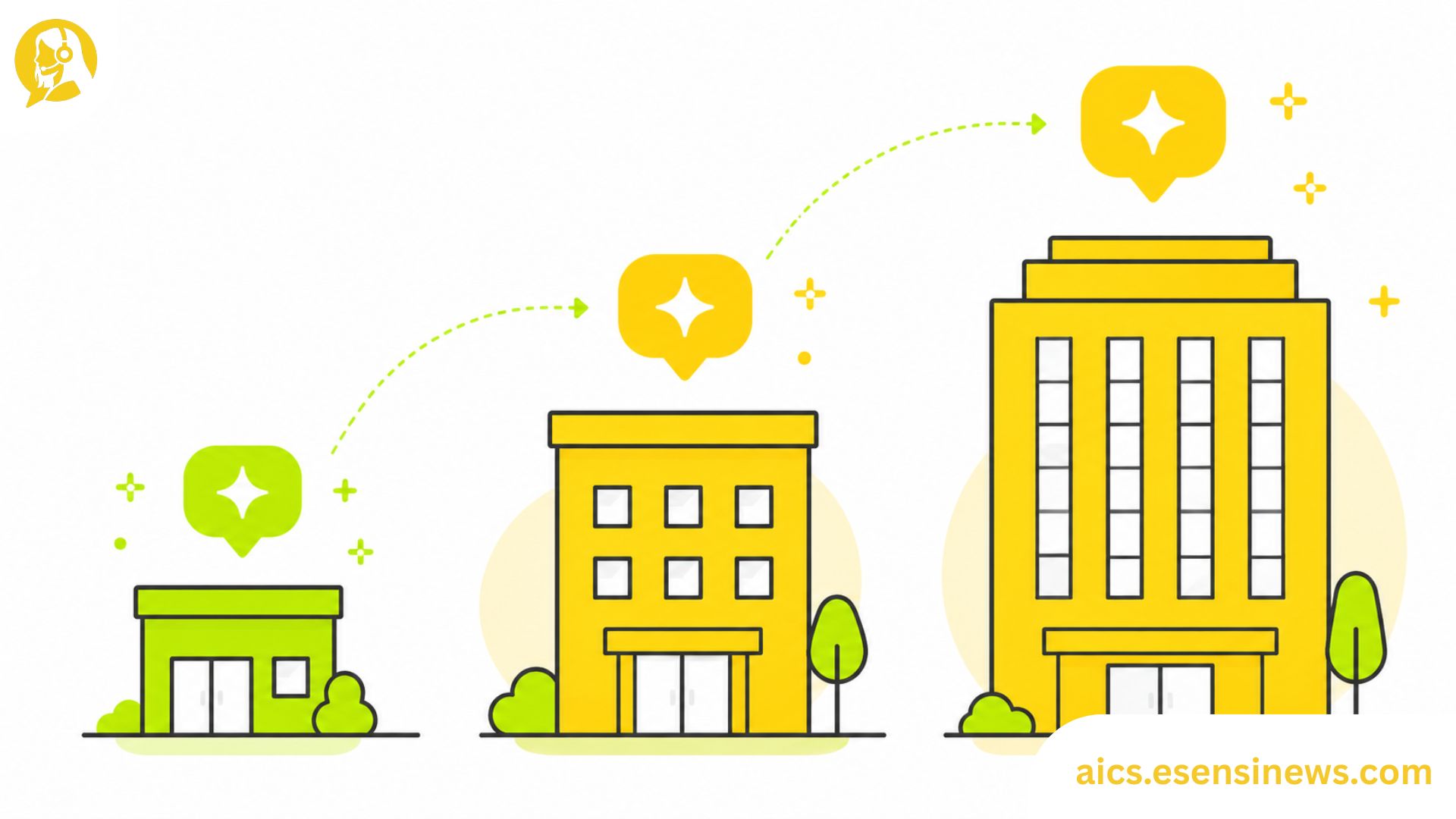
When CX leaders ask about companies using AI for customer service, they’re usually looking for one of two things: validation that AI adoption is genuinely widespread, or patterns they can learn from and apply to their own team. The first question has a simple answer adoption is broad across industries and company sizes. The second question is where the more useful insight lives.
What works for a 10,000-agent enterprise contact center looks very different from what works for a mid-market company with a 40-person support team or a small business with two customer service staff. The AI tools, the implementation approaches, and the outcomes all differ significantly by company size and context. Yet the lessons from each tier tend to be surprisingly transferable, as long as you’re drawing from the right tier for your situation.
This guide breaks down how companies using AI for customer service tend to approach it across three organizational scales, what patterns consistently show up within each tier, and the most transferable lessons for any CX team regardless of where they are in the adoption curve.
How Company Size Shapes AI Customer Service Adoption
Before getting into specific patterns, it helps to understand why company size is one of the most useful lenses for looking at AI customer service adoption.
Large organizations have more resources to invest, but they also have more complexity, more legacy systems, and more organizational inertia to navigate. Small businesses have fewer resources, but they can move faster and see the impact of changes more quickly. Mid-market companies often face the most interesting constraint set: enough volume to justify AI investment, but often without the internal technical teams that large enterprises have to manage complex deployments.
Understanding where your organization sits in this spectrum, and which tier’s adoption patterns are most relevant to your situation, is the starting point for drawing useful lessons from what other companies are doing.
Enterprise Companies Using AI for Customer Service
Typical Adoption Patterns
Enterprise organizations generally those with hundreds or thousands of support agents tend to approach AI customer service adoption with a level of organizational planning that smaller companies can’t always replicate but can learn from structurally.
Common patterns across enterprise AI customer service adopters:
- Phased, multi-year rollouts rather than single deployments, starting with one channel or use case and expanding based on measured results
- Cross-functional AI governance structures that bring together CX, IT, legal, and compliance stakeholders
- Heavy investment in data infrastructure before deploying AI, since enterprise AI performance is heavily dependent on the quality and volume of historical data available
- Dedicated internal AI operations roles, including conversation designers, AI performance analysts, and adoption managers
- Strong focus on change management, with structured agent training and communication programs that start well before go-live
What Smaller Teams Can Learn From Enterprise Adoption
Even without enterprise resources, the structural lesson applies at any scale: AI deployments that are planned as organizational change initiatives, not just technology installations, consistently perform better. Cross-functional involvement, agent training before launch, and phased scope are principles that work for a 40-person team as well as a 4,000-person floor.
Mid-Market Companies Using AI for Customer Service
Typical Adoption Patterns
Mid-market companies, typically those with support teams of 20 to a few hundred agents, often show the most pragmatic AI adoption patterns, partly because they face the most direct trade-off between capability and resource investment.
Common patterns across mid-market AI customer service adopters:
- Starting with agent-assist tools rather than fully automated customer-facing AI, since these reduce risk while still improving productivity
- Choosing platforms that integrate with existing helpdesk software rather than replacing the core ticketing system
- Prioritizing self-service knowledge base improvements as an early, lower-complexity AI use case
- Shorter pilot periods than enterprise (often four to six weeks rather than several months) due to faster internal decision cycles
- Leaning on vendor professional services more heavily during implementation, since internal technical depth is typically more limited
What Other Teams Can Learn From Mid-Market Adoption
Mid-market companies demonstrate that AI-assisted support, rather than fully automated AI, is often the most practical starting point regardless of company size. Starting with AI that supports humans rather than replacing them reduces risk, accelerates adoption among agents, and produces measurable improvements with less configuration complexity.
Small Business and Startup Adoption Patterns
Typical Adoption Patterns
Small businesses and startups using AI for customer service operate with the tightest constraints, but they also often move fastest and see the clearest per-dollar impact.
Common patterns across small business AI customer service adopters:
- Starting with a single, high-impact use case most commonly either FAQ automation or after-hours availability
- Using out-of-the-box AI features within existing tools (helpdesk platforms, website builders, CRM systems) rather than deploying dedicated AI platforms
- Focusing on AI that directly reduces after-hours missed contacts, since this tends to have the most visible immediate revenue impact
- Shorter evaluation cycles driven by urgency and limited alternatives analysis time
- Higher reliance on vendor onboarding support since internal configuration expertise is often limited
What Other Teams Can Learn From Small Business Adoption
The small business lesson is arguably the most universally applicable: identifying one specific, high-cost problem (missed calls, unanswered after-hours messages, repetitive FAQ volume) and deploying AI specifically to solve that problem produces clearer ROI than a broad, feature-rich deployment with unclear primary purpose.
Patterns That Show Up Across All Company Sizes
Despite the differences in scale and resource level, a few patterns show up consistently across companies using AI for customer service, regardless of size.
The Pilot Principle
Almost universally, the companies that report the most successful AI customer service outcomes started with a limited, defined pilot rather than a broad rollout. The pilot scope varies by company size, but the discipline of starting small, measuring carefully, and expanding deliberately is consistent.
Human Escalation Is Non-Negotiable
Across every company size, the AI deployments that generate the most customer satisfaction complaints share one characteristic: inadequate or confusing escalation paths to human agents. The companies that handle this best treat human escalation as a designed feature of the AI experience, not a fallback for AI failure.
Ongoing Optimization Outperforms Initial Configuration
Companies that invest in ongoing performance review and optimization after go-live consistently outperform those that treat initial configuration as the finished product. This holds regardless of company size or AI platform.
Agent Involvement Predicts Adoption Quality
Across enterprise, mid-market, and small business deployments, the quality of agent adoption correlates closely with how early and how meaningfully frontline agents were involved in the design and rollout process.
Pros and Cons of Learning From Other Companies’ AI Customer Service Adoption
Pros ✅
- Reduces trial-and-error costs by applying lessons from others’ proven patterns
- Helps calibrate realistic expectations by understanding what companies at a similar scale have achieved
- Identifies the right starting use case based on what’s worked across similar contexts
- Provides a framework for internal conversations about pace and scope of adoption
Cons ❌
- Every organization’s context differs, so direct application without adaptation rarely works well
- Success stories tend to be more visible than failures, creating selection bias in what gets shared publicly
- Company-specific factors like culture, existing tech stack, and customer base significantly affect what will work
- What worked two years ago may not reflect the current state of AI capabilities or best practices
Practical Tips for Applying These Lessons
- Identify your organizational tier first (enterprise, mid-market, or small business) and draw primarily from patterns at that scale.
- Start with the pilot principle, regardless of company size, and resist pressure to skip straight to broad deployment.
- Invest in human escalation design early, since this is the failure point most consistently shared across companies that report poor AI customer service outcomes.
- Build ongoing optimization into your plan from the start, with a named owner and dedicated review cadence after go-live.
- Involve frontline agents early the companies with the smoothest AI adoption consistently did this.
Common Mistakes Companies Make When Adopting AI for Customer Service
- Comparing themselves to enterprise adoption patterns when they’re a mid-market or small business, leading to scope and complexity mismatches
- Skipping the pilot phase under pressure to show results quickly
- Treating go-live as the endpoint rather than the beginning of ongoing optimization
- Underinvesting in agent involvement and then struggling with resistance and low adoption quality
- Focusing on the most impressive AI features rather than the use case with the clearest, most immediate value
FAQ: Companies Using AI for Customer Service
1. What kinds of companies are using AI for customer service right now? AI customer service adoption is widespread across industries and company sizes, from large enterprise contact centers to small businesses using AI for after-hours availability and FAQ automation.
2. What do successful companies using AI for customer service have in common? They consistently start with a defined pilot, design human escalation carefully, involve frontline agents early, and invest in ongoing optimization after go-live.
3. Is AI customer service only for large companies? No. Small businesses and startups have adopted AI effectively for specific, high-impact use cases like after-hours availability and FAQ deflection, often with faster results than larger organizations.
4. What’s the most common starting point for companies adopting AI for customer service? Agent-assist tools, FAQ automation, and after-hours availability coverage are the most common early use cases across company sizes, because they deliver measurable value with manageable implementation complexity.
5. What’s the biggest mistake companies make when adopting AI for customer service? Skipping or shortening the pilot phase under pressure to show results quickly is one of the most consistent mistakes, often leading to poor adoption quality and difficult course corrections.
6. How long does it typically take for companies to see results from AI customer service? Basic improvements in response time and deflection rates can be visible within weeks of a well-configured pilot. Broader operational improvements from ongoing optimization typically develop over several months.
7. What should a CX team focus on when learning from other companies’ AI adoption? Focus on patterns from companies at a similar scale and in a similar industry, since adoption approaches that work well for enterprises often don’t directly translate to mid-market or small business contexts.
Conclusion
Companies using AI for customer service span every industry and company size, and the patterns they follow differ meaningfully by scale. But the most transferable lessons show up consistently across all of them: start with a pilot, design human escalation as a feature, involve agents early, and treat go-live as the beginning of optimization rather than the end of the project.
The takeaway? Don’t try to replicate enterprise-scale adoption patterns if you’re a mid-market team, or vice versa. Find the tier that most closely matches your scale, draw the relevant lessons, and apply them to your specific context. That’s how other companies’ experience actually becomes useful to your own operation.
Ready to Apply These Lessons to Your Team?
If this guide gave you a clearer picture of where to start, identify which adoption tier matches your organization and map one lesson from that tier to your current situation. Know another CX leader exploring what peers are doing with AI? Share this with them. And if you’re planning to explore more AI adoption strategies, bookmark this page so it’s easy to find again. Here’s to learning from the right examples, not just the most visible ones.


Leave a Reply