
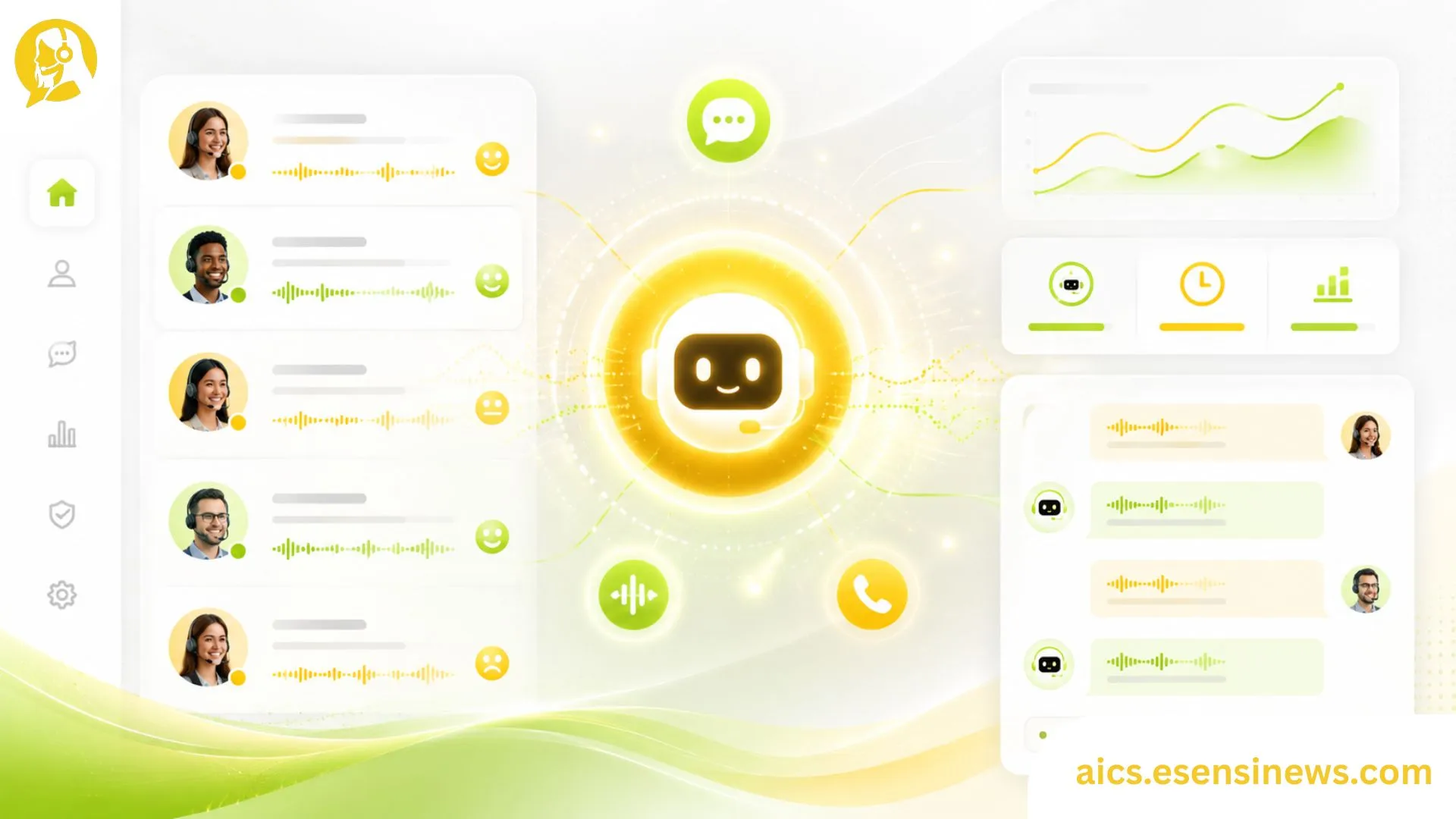
Customer expectations have quietly outpaced what a traditional call center can deliver. People want answers in seconds, not after twenty minutes of hold music, and they want it on whatever channel they happen to be using that day chat, phone, email, or social media. That gap between expectation and reality is exactly why AI-powered contact center solutions have moved from “nice to have” to a board-level priority for companies that actually want to keep customers around.
I’ve spent the better part of a decade writing about and testing customer service technology, and if there’s one thing I’ve learned, it’s this: the businesses winning right now aren’t the ones with the biggest support teams. They’re the ones pairing human agents with AI in a way that actually feels helpful instead of robotic. This piece breaks down how that pairing works, what it costs, where it stumbles, and what’s coming next.
Last updated: June 2026.
The Evolution of Customer Service
Customer service didn’t get here overnight. In the 1990s, support meant a phone line and a hold queue. The 2000s brought email tickets and the first wave of clunky IVR systems the ones that made you scream “REPRESENTATIVE” into the phone five times. Then came live chat in the 2010s, followed by chatbots that, let’s be honest, were mostly scripted decision trees pretending to be smart.
What changed everything was large language models hitting a quality bar where a bot could actually understand intent, not just match keywords. According to Zendesk’s 2025 CX Trends research, a large share of support leaders said AI had already changed how their team operates day to day. That’s not a marginal shift that’s a structural one.
Today’s AI-powered contact center solutions don’t just answer FAQs. They route calls based on sentiment, summarize conversations in real time, and predict which customers are about to churn before a human even picks up the phone. It’s the difference between a moped and a motorcycle with proper gears both get you there, but only one of them keeps up when traffic gets heavy.
Key Benefits of AI in Customer Service
The benefits aren’t theoretical anymore; companies have years of deployment data to point to. Here’s what shows up consistently across enterprise case studies and vendor benchmarks.
- Faster resolution times. AI-powered contact center platforms can resolve routine tier-1 queries password resets, order status, billing questions in under a minute, compared to an industry average of 6 to 12 minutes for a human-only queue.
- 24/7 availability without 24/7 payroll. A virtual agent doesn’t need overtime pay or a night shift differential. For businesses with global customers, that alone can be the deciding factor.
- Lower cost per contact. McKinsey has estimated that AI-driven automation can cut customer service costs by 20 to 30 percent when deployed well, mostly by deflecting simple tickets away from expensive human agents.
- Consistency. A well-trained AI doesn’t have an off day. It won’t snap at a customer after a rough shift, which speaking from personal experience managing a small support team years ago is more valuable than people give it credit for.
- Better data capture. Every interaction becomes structured data: intent, sentiment, resolution path. That’s gold for product teams trying to figure out what’s actually breaking for customers.
None of this means humans are obsolete. It means the easy 60-70% of tickets get handled instantly, freeing agents for the messy, emotional, or high-stakes conversations where a person genuinely makes the difference.
How AI-Powered Contact Centers Work
At a technical level, an AI-powered contact center is less “one big bot” and more a stack of specialized components working together.
The Front Door: Natural Language Understanding
When a customer types or says something, an NLU engine parses intent and entities. “Where’s my order #4471?” gets broken down into intent (order status) and entity (order number), then routed to the right backend system no human needed unless something’s gone wrong.
The Brain: Orchestration and Knowledge Retrieval
This is where retrieval-augmented generation (RAG) comes in. The AI pulls from a company’s actual knowledge base, return policy, and account data instead of just guessing, which is what keeps answers accurate rather than confidently wrong.
The Handoff: Human-in-the-Loop Escalation
Good systems know their limits. If sentiment analysis detects frustration, or the query touches something sensitive like a refund dispute, the conversation gets escalated to a human agent with full context already summarized, so the customer never has to repeat themselves. That last part matters more than most vendors admit; repeating your problem to a new person is the single biggest complaint in CX surveys, year after year.
Common AI Technologies Used in Contact Centers
Not every “AI feature” on a vendor’s pricing page does the same job. Here’s a quick comparison of the core technologies you’ll run into when evaluating AI-powered contact center solutions.
| Technology | What It Does | Typical Use Case | Approx. Cost Range (Enterprise) |
|---|---|---|---|
| Conversational AI / Chatbots | Handles text and voice queries end-to-end | FAQs, order tracking, simple billing | $500–$3,000/month per 1,000 conversations |
| Speech Recognition (ASR) | Converts voice to text in real time | Call transcription, voice bots | Often bundled, $0.01–$0.05 per minute |
| Sentiment & Emotion Analysis | Flags frustration or urgency mid-call | Real-time escalation, QA scoring | $200–$1,500/month add-on |
| Predictive Analytics | Forecasts churn risk, call volume spikes | Staffing decisions, proactive outreach | Custom enterprise pricing |
| Agent-Assist / Copilot | Suggests responses to live human agents | Reducing average handle time | $40–$120 per agent seat/month |
Pricing varies a lot by vendor and contract size, so treat these as ballpark figures rather than gospel always get a quote based on your actual call volume.
Enhancing Customer Experience with AI
Here’s where I’ll push back a little on the marketing hype: AI doesn’t automatically improve customer experience. Badly implemented AI makes things worse ask anyone who’s been stuck in an endless bot loop with no clear way to reach a human. The companies that actually move CSAT scores up do a few things right.
First, they make escalation obvious and instant, not buried behind three menus. Second, they use AI to personalize, not just automate pulling up purchase history so the conversation feels like talking to someone who already knows you, instead of starting from zero. Third, they monitor tone. An AI-powered contact center that responds to an angry customer with chipper customer-service-speak is going to make things worse, not better.
“We didn’t see CSAT improve until we let the AI handle the boring stuff and trained our agents to focus entirely on emotionally complex cases. The split mattered more than the tech itself,” a contact center operations lead noted in a 2025 CCW (Customer Contact Week) panel discussion.
If you’re evaluating AI-powered contact center solutions for your own business, this is the part worth spending real budget on not just buying the flashiest model, but designing the experience around when AI hands off to a human and how smoothly that happens.
Challenges in Implementing AI-Powered Contact Centers
Real talk: adoption isn’t plug-and-play, no matter what the sales deck says. Here’s an honest look at both sides.
✅ Pros
- Significant reduction in average handle time and operational cost
- Scales instantly during seasonal spikes (think Black Friday) without hiring temp staff
- Improves consistency in tone, policy adherence, and compliance scripting
- Frees senior agents to focus on retention and high-value accounts
❌ Cons
- Upfront integration cost and IT resources can be substantial, especially with legacy CRM systems
- Poorly tuned models can hallucinate policy details, creating real compliance risk
- Customers in certain demographics (older populations, complex B2B accounts) often still prefer a human first
- Change management is hard agents sometimes see AI as a threat rather than a tool, which hurts adoption internally
There’s also a data privacy angle that doesn’t get discussed enough. Feeding customer PII into a third-party AI model means your vendor contracts and data handling agreements need real legal scrutiny, not a rubber stamp. If you’re in healthcare, finance, or anything HIPAA- or PCI-adjacent, budget extra time for compliance review before go-live.
Case Studies: Successful AI Integration in Customer Service
A few examples worth knowing, paraphrased from publicly reported results rather than vendor marketing copy:
A major airline rolled out an AI-powered virtual agent for flight status and rebooking during weather disruptions. During a single severe winter storm event, the system reportedly handled tens of thousands of rebooking conversations that would have otherwise overwhelmed phone lines, with reported wait time reductions in the range of 70-80% compared to the prior year’s storm season.
A mid-sized e-commerce retailer integrated agent-assist copilots into their existing support desk rather than replacing agents outright. Average handle time dropped by roughly 25%, and this is the part people skip agent satisfaction scores actually went up, because reps spent less time digging through internal wikis and more time actually talking to customers.
A regional bank used predictive analytics paired with conversational AI to flag at-risk customers before they called to close their accounts, triggering proactive retention outreach. Reported churn reduction landed in the high single digits over one fiscal year, which on a large deposit base is not a small number.
The pattern across all three: AI worked best when it amplified existing human teams instead of trying to replace them outright on day one.
Future Trends in AI and Customer Service
A few things worth watching over the next 12-18 months. Voice AI is closing the uncanny-valley gap fast newer voice models are getting hard to distinguish from a human agent in short calls, which raises its own set of disclosure and ethics questions that regulators are starting to pay attention to. Multimodal support is also growing, where a single AI session can handle a screenshot, a voice note, and a typed follow-up question without losing context.
There’s also a quieter trend: smaller, specialized models fine-tuned on a company’s own data are starting to outperform giant general-purpose models for narrow contact center tasks, at a fraction of the inference cost. For businesses comparing AI-powered contact center solutions on price, that shift toward smaller fine-tuned models is going to matter a lot over the next couple of budget cycles.
If you want a deeper technical breakdown of where this is headed, our AI contact center resource hub tracks these shifts as new platforms roll out.
Frequently Asked Questions
Is an AI-powered contact center solution expensive to set up? It depends heavily on scale and integration complexity. Small businesses can get started with cloud-based platforms for a few hundred dollars a month, while enterprise deployments with custom integrations and compliance work can run into six figures annually. Most vendors offer tiered pricing based on conversation volume.
Will AI replace human customer service agents entirely? Not in the near term, and probably not ever for complex or emotionally sensitive cases. The realistic trajectory is AI absorbing routine, repetitive tickets while human agents handle escalations, relationship management, and anything requiring judgment.
How accurate are AI chatbots in handling customer complaints? Accuracy varies widely by implementation, but well-trained systems using retrieval-augmented generation on a company’s actual policy documents typically resolve 60-80% of routine queries correctly without escalation. Accuracy drops sharply for ambiguous or multi-part requests.
What industries benefit most from AI contact center technology? Airlines, e-commerce, telecom, banking, and insurance see the strongest ROI, mainly because they handle extremely high contact volumes with a lot of repetitive query types order status, billing, account changes that are easy to automate well.
How do I choose between different AI-powered contact center solutions? Compare based on integration compatibility with your existing CRM, transparent pricing per conversation or per seat, escalation handling quality, and whether the vendor allows fine-tuning on your own knowledge base rather than locking you into a generic model.
Conclusion: Embracing AI for a Better Customer Experience
AI-powered contact center solutions aren’t a silver bullet, and any vendor promising otherwise is overselling. But the data is consistent across industries: faster resolution, lower cost per contact, and when implemented thoughtfully happier customers and less burned-out agents. The companies getting real value out of this technology treat AI as a teammate for their support staff, not a replacement bolted on to cut headcount.
If you’re researching options for your own business, start by mapping which ticket types are repetitive enough to automate safely, then work backward into the right platform. You can explore current platform comparisons and deployment guides at aics.esensinews.com to see how different AI-powered contact center solutions stack up for your specific use case.


Leave a Reply