
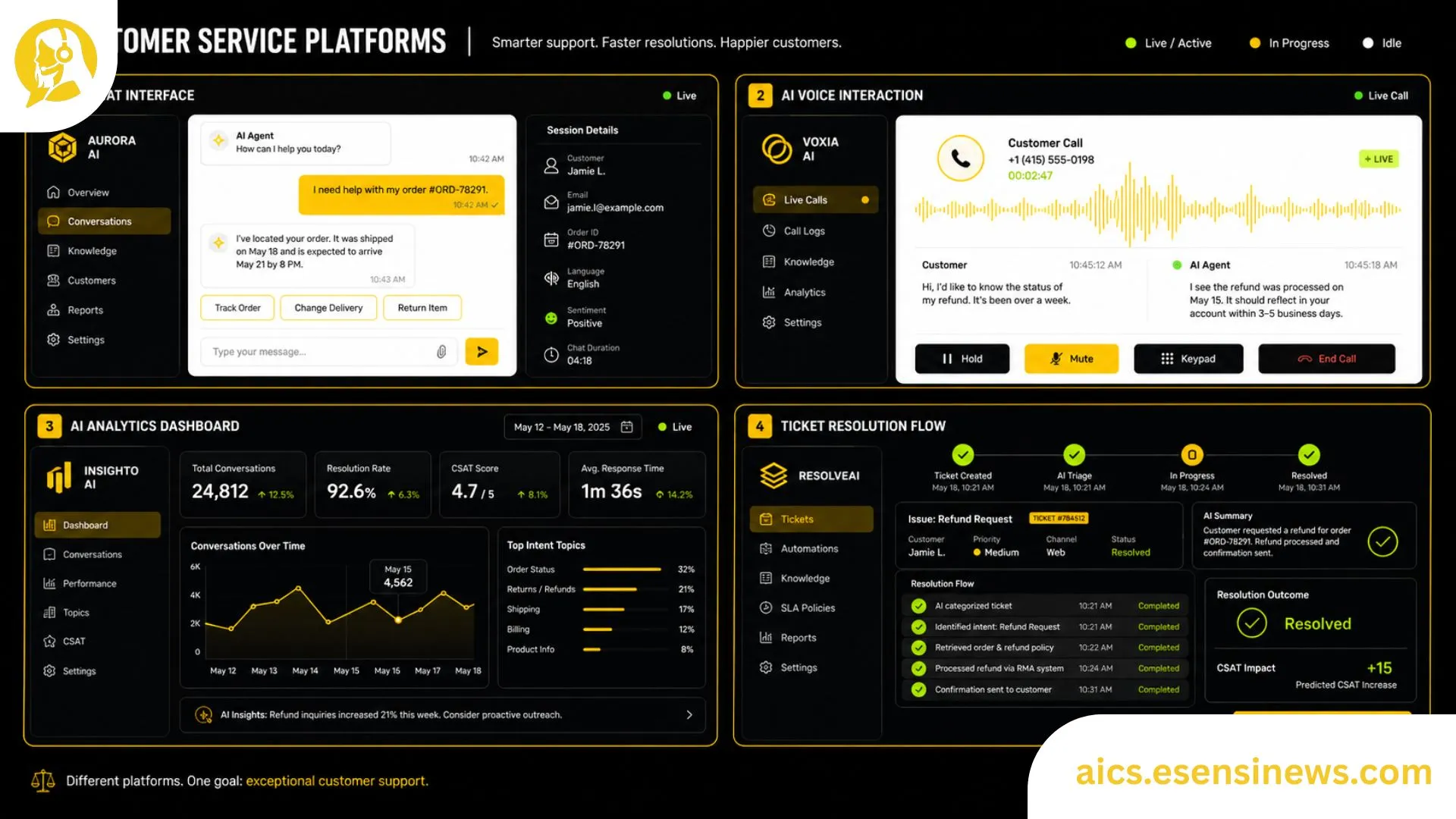
Choosing an AI customer support platform in 2026 feels a lot like buying a car in the early 2000s the category exists, there are real options, but the spec sheets are confusing, every salesperson claims theirs is best, and the stakes of picking wrong are uncomfortably high.
The AI customer service companies market has matured fast. What started as basic FAQ chatbots has become a full-stack industry producing autonomous agents that process refunds, resolve disputes, onboard new users, and escalate edge cases to human agents all inside a single conversation thread, often without any human ever touching the ticket.
In this guide, I’m cutting through the vendor noise. No sponsored rankings, no vague “industry leaders” language. Just an honest breakdown of which platforms are actually delivering results in 2026, what they cost, where they fall short, and how to figure out which one fits your specific operation.
Why AI Has Become Central to Modern Customer Support
Support teams didn’t adopt AI because it sounded cool. They did it because the math stopped working any other way.
Customer expectations have shifted dramatically. According to Salesforce’s 2025 State of the Connected Customer report, 72% of consumers now expect a response to support inquiries within 30 minutes or less up from 46% just five years ago. Meanwhile, support ticket volumes are climbing across virtually every industry, driven by e-commerce growth, subscription economy complexity, and an expanding global customer base.
You can’t hire your way out of that problem at a reasonable cost. A fully-loaded customer service agent in the US runs $35,000–$55,000 per year in salary alone, plus benefits, training, turnover, and management overhead. An AI agent handling the same tier-1 volume costs $0.30–$1.50 per resolved interaction.
The math is simple. Implementation is not.
That’s where AI customer service companies come in not just providing software, but offering the infrastructure, integrations, training data pipelines, and ongoing optimization that turn a tech purchase into actual business impact. The difference between a vendor and a partner matters enormously in this category. I’ve watched companies waste six-figure budgets on platforms that looked great in demos but never actually fit their workflow.
The AI Contact Center landscape has matured enough that buyers now have meaningful options at every budget tier. But that also means more ways to pick wrong.
What Separates Good AI Customer Service Solutions From Forgettable Ones
Before naming names, it’s worth being clear about what the best platforms actually have in common because every vendor will tell you they check all the boxes. The ones that genuinely do tend to share a few non-negotiable traits.
Intent Accuracy on Messy Real-World Data
Vendor demos always look pristine. Real customer language is not. “my thing wont work wtf” and “I’m unable to access my account and have tried resetting three times” both express the same intent, but they’re written by completely different people in completely different emotional states. Good NLU handles both. Bad NLU handles the second one fine and completely fumbles the first.
The only way to evaluate this honestly is to test candidate platforms against your own historical ticket data specifically your messiest, most ambiguous tickets before committing to a contract.
Action Capability, Not Just Responses
An AI agent that can only answer questions is a fancy FAQ. Real business value comes from agents that can do things: process a refund, update a shipping address, freeze a compromised account, schedule a callback, cancel a subscription. That requires deep integration with your backend systems CRM, order management, payment processor, helpdesk.
Platforms that charge separately for integrations, or that require custom development to connect basic systems, end up being significantly more expensive than their sticker price suggests.
Human Handoff That Doesn’t Make Customers Repeat Themselves
This one should be obvious but somehow still gets botched by expensive platforms. When an AI agent hits a wall and transfers to a human, the human agent must receive the full conversation transcript, the customer’s account data, and any actions already taken. Anything less means the customer starts over and CSAT craters.
Honest Analytics
Deflection rate without resolution rate is a vanishing trick. It’s easy to “deflect” tickets by just closing them or returning generic responses. What you actually need to know: of the interactions the AI handled, how many ended with the customer’s issue genuinely resolved? That metric and platforms that surface it honestly separates the tools worth paying for from the ones padding their metrics.
Top AI Customer Service Companies in 2026
Here’s where we get specific. This isn’t an exhaustive list of every player in the space it’s a focused breakdown of platforms that are delivering measurable results for real customers in 2026, across different budget tiers and use cases.
Intercom (Fin AI Agent)
Intercom’s Fin product has become one of the most widely deployed AI agents in the SaaS and tech company space, and for good reason. It pulls directly from your help documentation to generate contextual responses not templates, not decision trees, but generated answers grounded in your actual content. Resolution rates for SaaS companies with well-maintained help docs typically land in the 60–75% range.
The pricing model is usage-based on top of per-seat costs, which makes it predictable for high-volume teams but can surprise smaller deployments that assumed a flat monthly fee. Starting costs run around $39/seat plus roughly $0.99 per resolution for the AI agent tier.
Best for: SaaS companies, tech startups, teams with strong existing documentation.
Zendesk AI
Zendesk has been building AI capabilities into its platform for years, and the 2025–2026 iteration is notably stronger than earlier versions. The advantage is deep native integration if you’re already on Zendesk, the AI features live inside your existing workflow without a separate implementation project.
The Intelligent Triage feature alone is worth mentioning: it automatically categorizes and routes incoming tickets based on intent and urgency, reducing the manual triage burden on human agents. Resolution automation quality varies by industry, but it’s strong for e-commerce and SaaS.
Pricing starts at $55/agent/month for the Suite plan, with AI features included. Enterprise tiers with advanced AI customization require custom quotes.
Best for: Mid-market and enterprise teams already on Zendesk, or those wanting an all-in-one platform.
Salesforce Einstein for Service
If you’re running enterprise operations with Salesforce as your CRM backbone, Einstein for Service is the most natural AI extension of that investment. The native CRM integration means the AI agent has access to complete customer history, purchase records, case history, and sentiment data enabling genuinely personalized support at scale.
The trade-off is cost and complexity. Einstein is enterprise-grade in both capability and price tag. Deployment typically requires Salesforce partner involvement, and implementation timelines of 4–8 months are common for full deployments. This is not a tool for a 10-person support team.
Best for: Large enterprises with Salesforce as their core CRM and complex, multi-step support workflows.
Ada Support
Ada has carved out a specific niche: highly customizable AI agents for e-commerce and consumer subscription brands. Where some platforms force you into their conversation flow templates, Ada’s no-code builder gives non-technical teams significant control over how the agent behaves, what it says, and how it escalates.
Ada’s pricing is custom, positioning them in the mid-market to enterprise range. Their case study library skews heavily toward consumer brands retail, DTC, subscription boxes which is where the platform performs best.
Best for: E-commerce brands, DTC companies, consumer subscription services with high return/order inquiry volume.
Freshdesk (Freddy AI)
Freshdesk’s Freddy AI is the most accessible entry point for SMBs that want real AI capability without enterprise price tags. Freddy handles ticket categorization, auto-resolution of common queries, and agent assist features that help human agents respond faster with suggested responses.
Pricing starts at $29/agent/month and scales with features. The NLU quality is solid for standard use cases, though it lags behind Intercom and Zendesk for complex, nuanced queries. For teams handling straightforward support volumes under 5,000 tickets/month with predictable query types Freddy is genuinely worth considering.
Best for: SMBs, early-stage companies, teams with limited implementation budgets.
Google CCAI (Contact Center AI)
Google’s Contact Center AI is a different kind of product than the others on this list it’s infrastructure-level AI that powers voice and chat channels rather than a complete support platform. Telecoms, large financial institutions, and enterprise contact centers use CCAI to add AI capability to existing telephony systems.
The voice AI quality is exceptional. If phone support is your primary channel and you’re handling serious volume (think: 50,000+ calls/month), CCAI is worth evaluating seriously. But it requires significant technical implementation and isn’t designed for teams without dedicated engineering resources.
Best for: Large enterprises with high-volume phone support channels, particularly in financial services and telecoms.
Platform Comparison: AI Customer Service Companies Side by Side
| Company | Starting Price | NLU Quality | Action Capability | Voice Support | Best Fit |
|---|---|---|---|---|---|
| Intercom Fin | $39/seat + usage | ★★★★★ | High | No | SaaS, tech |
| Zendesk AI | $55/agent/month | ★★★★☆ | High | Limited | Mid-market, enterprise |
| Salesforce Einstein | Custom (enterprise) | ★★★★★ | Very High | Via CCAI | Large enterprise |
| Ada Support | Custom pricing | ★★★★☆ | High | No | E-commerce, DTC |
| Freshdesk Freddy | $29/agent/month | ★★★☆☆ | Medium | No | SMB |
| Google CCAI | Custom (usage-based) | ★★★★★ | High | Yes (primary) | Enterprise phone |
All pricing as of Q2 2026. Enterprise tiers require direct quotes.
Case Studies: What Real AI Implementation Actually Looks Like
A Subscription Box Company Cuts Ticket Volume by 58%
A mid-size DTC subscription brand roughly 200,000 active subscribers was drowning in tier-1 support volume. “Where’s my box,” “can I skip a month,” “how do I cancel” accounted for nearly 60% of all incoming tickets. Two human agents per shift couldn’t keep up. CSAT was hovering around 3.6/5.
They deployed Ada Support integrated with their subscription management platform. After a 90-day implementation and soft launch:
- 58% of total ticket volume handled end-to-end by AI
- Average resolution time: from 4.8 hours to 6 minutes
- CSAT for AI-handled tickets: 4.1/5
- Human agents shifted almost entirely to complex cancellation saves and billing disputes
The team lead, posting in a customer success community forum in early 2026, noted: “The bot doesn’t replace our agents it just handles the stuff that was boring and repetitive so they can focus on interactions that actually require judgment.”
Regional Bank Cuts Fraud Response Time From 28 Minutes to 90 Seconds
A regional US bank operating 47 branches was handling after-hours fraud reports entirely through a human overnight team. Average time to freeze a compromised card: 28 minutes. During high-volume periods, that stretched to 45+.
They integrated Google CCAI with their fraud detection and core banking systems. The AI voice agent now handles card freeze requests autonomously, with identity verification built into the flow.
Result: 90-second average resolution for card freeze requests, 24/7. The overnight human team shifted to handling exceptions disputes requiring human judgment, cases involving account compromise beyond a single card.
Comparing AI Customer Service Platforms: What the Demos Don’t Show You
Vendor demos are optimized. They show you the platform working perfectly on a pre-selected use case with clean data and a cooperative customer. Real deployments are messier.
A few things to probe specifically during evaluation:
Ask about hallucination handling. LLM-based AI agents can generate confident wrong answers. Ask vendors: what happens when the AI isn’t sure? What’s the confidence threshold for routing to a human? How do you prevent the agent from fabricating information about your products or policies?
Test with your worst tickets, not your best. Take 50 of your most confusing, angry, or ambiguous real tickets from the past 6 months. Run them through the platform during evaluation. See how the NLU performs on real noise, not curated demo scenarios.
Understand the integration timeline. “Easy integrations” in a sales deck often means “your developer will spend 3 weeks on this.” Ask specifically: how long does integration with your CRM and helpdesk actually take? Get that estimate in writing before signing.
Clarify what’s included vs. what’s extra. Some platforms charge per resolution, per seat, per integration, and per API call. Model out your expected volume and get a fully-loaded cost estimate not just the headline monthly price.
Challenges and Limitations Worth Being Honest About
Real talk: AI customer service isn’t a magic bullet. Every platform on this list has real limitations, and any vendor who tells you otherwise is selling you something.
✅ AI is genuinely strong at: High-volume tier-1 queries, consistent policy application, 24/7 coverage, multi-language support (major languages), analytics and reporting, integration with backend systems for action-taking.
❌ AI still struggles with: Emotionally complex interactions (grief, serious financial distress, medical urgency), edge cases outside training distribution, situations requiring genuine judgment or ethical nuance, highly niche or domain-specific technical problems, and anything that requires building human trust over time.
The hallucination problem is real and unsolved. LLM-based agents can confidently generate false information. In a customer service context, that means an agent might cite a return policy that doesn’t exist, confirm a feature that isn’t available, or promise a timeline the company can’t meet. Mitigation strategies (grounding to vetted content, confidence thresholds, human review) help, but don’t eliminate the risk entirely.
Implementation takes longer than vendors admit. Budget 3–6 months for a production-ready deployment. That’s not a knock on any specific platform it’s the reality of integrating with existing systems, training on your specific data, and building conversation flows that match your actual use cases. Teams that rush this phase end up with AI agents that perform poorly and take the blame for bad deployments.
Ongoing maintenance is underestimated. Products change. Policies update. New query types emerge. An AI agent trained six months ago may be confidently wrong about things that changed last quarter. Budget for quarterly model reviews and assign internal ownership for the AI agent’s ongoing performance.
Pro & Cons: Investing in AI Customer Service Platforms
✅ Pros
- Handles tier-1 volume at a fraction of human agent cost
- Operates 24/7 without overtime, holiday pay, or burnout
- Delivers consistent responses no policy interpretation drift
- Resolves common issues in seconds rather than hours
- Scales instantly during seasonal peaks or viral traffic spikes
- Generates granular analytics that surface systemic support issues
- Frees human agents for complex, high-value interactions
❌ Cons
- Enterprise implementation can cost $50,000–$250,000+ upfront
- Hallucination risk requires careful guardrails and ongoing monitoring
- LLM-based agents need constant content updates to stay accurate
- Poor implementation actively damages customer trust and CSAT scores
- Integration complexity with legacy systems often delays timelines
- Multilingual quality uneven outside major world languages
- Vendor lock-in becomes a real concern after deep integration
Future Trajectory: Where AI Customer Support Is Heading
The platforms shipping in 2026 are already meaningfully different from what was available in 2023. The trajectory for 2027–2029 points toward a few clear directions.
Agentic workflows are the big shift. Instead of AI agents that answer questions within a conversation, we’re moving toward agents that autonomously execute multi-step resolution workflows across multiple systems without a human in the loop for anything except genuinely ambiguous or high-stakes decisions.
Proactive support is gaining real traction. AI systems that monitor product usage patterns, detect friction before a ticket is created, and reach out proactively to at-risk customers are moving from pilot programs to production deployments at enterprise scale.
Voice AI parity with text is closer than most people expect. The gap between text-channel and voice-channel AI quality has been closing rapidly. By 2027–2028, voice AI agents capable of handling the same complexity as text-based agents will be a realistic expectation across most enterprise platforms.
How to Choose the Right AI Customer Service Company for Your Business
This is the buying guide section and it’s worth slowing down here, because the decision process matters as much as the platform itself.
Step 1 – Audit your ticket data first. Pull 6 months of historical tickets. Categorize by intent. If your top 5 intents account for 55%+ of volume, you have a clear, high-ROI starting point. That’s what you’re automating in phase one.
Step 2 – Define success metrics before you start talking to vendors. Deflection rate, resolution rate, average handling time, CSAT. Set a baseline and a 12-month target. Without that, you can’t evaluate vendor claims or know if your deployment is working.
Step 3 – Match platform to your actual scale and stack. A 500-ticket/month operation doesn’t need Salesforce Einstein. A 50,000-ticket/month enterprise shouldn’t be running on a $29/month SMB tool. Be realistic about where you are now and where you’ll be in 18 months.
Step 4 – Evaluate integration fit, not just features. The most capable AI agent is only as useful as its ability to connect with your systems. Prioritize platforms that have proven, maintained integrations with your specific CRM and helpdesk stack.
Step 5 – Pilot before committing. Most enterprise platforms will offer a proof-of-concept period. Take it seriously not just for the demo scenario they recommend, but for your messiest real-world cases.
For industry-specific breakdowns and deployment case studies across verticals, the team at AICS has done deep research on AI contact center implementations worth a read before you narrow your vendor shortlist.
FAQ: AI Customer Service Companies
Q1: Which AI customer service company is best for small businesses?
Freshdesk’s Freddy AI is the most accessible starting point, with plans beginning at $29/agent/month and solid NLU quality for standard use cases. Tidio is another option for very small operations at $19/month, though its AI capability is more limited. The key for small businesses: don’t overbuy. A platform optimized for enterprise-scale deployments will be expensive to implement, require technical resources you may not have, and include capabilities you won’t use for years.
Q2: How much should a company budget for an AI customer service platform?
For SMBs: $200–$500/month covers most Freshdesk or Tidio deployments. Mid-market companies should budget $1,000–$5,000/month for platforms like Intercom or Zendesk, plus implementation costs of $10,000–$30,000 for proper setup. Enterprise deployments with Salesforce Einstein, Ada, or custom solutions can range from $50,000–$250,000+ for initial implementation, with ongoing licensing and maintenance on top. Get a fully-loaded cost estimate headline pricing rarely reflects total cost of ownership.
Q3: Can AI customer service platforms handle multiple languages?
Yes, major languages are well supported across most enterprise platforms. Spanish, French, German, Portuguese, Japanese, and Chinese (Mandarin) are typically included in base offerings from platforms like Zendesk and Intercom. Less common languages regional dialects, smaller market languages often rely on translation layers that degrade accuracy. If multilingual support is critical for your customer base, test specifically in those languages during the evaluation period and don’t rely on vendor claims alone.
Q4: How long before an AI customer service deployment delivers ROI?
Most well-implemented mid-market deployments hit positive ROI within 6–9 months. The calculation: cost of implementation + monthly platform cost vs. ticket deflection savings + agent time freed up. Companies with clear tier-1 deflection opportunities (high volume, predictable query types) see faster returns. Those with complex, highly variable support needs take longer to show clear ROI because implementation and training require more runway.
Making AI Work for Your Support Operation
The AI customer service companies market in 2026 offers real solutions at every price point from $29/month SMB tools to enterprise platforms built for hundreds of thousands of interactions per month. The technology works. The ROI math holds up. The implementations that fail aren’t failing because AI isn’t capable. They’re failing because deployment was rushed, integration was incomplete, or the wrong platform was chosen for the actual use case.
If there’s one frame I’d encourage: think about AI customer service as infrastructure, not software. You’re not buying an app that works out of the box. You’re building a system that needs proper setup, ongoing tuning, and internal ownership to perform well. Companies that approach it that way with patience, clear metrics, and realistic timelines consistently see the results the vendor demos promised.
Start with your highest-volume, lowest-complexity intents. Pick a platform that fits your current scale. Invest in a proper implementation. Measure against a defined baseline. Expand from there.
For a deeper look at how specific AI contact center deployments have played out across industries including what went wrong and how teams recovered check out the resources at AICS. It’s one of the more honest breakdowns I’ve come across in a space full of vendor-sponsored content.
This article reflects information current as of June 2026. Pricing, platform features, and vendor offerings change frequently. Always verify current details directly with vendors before making purchasing decisions.


Leave a Reply