
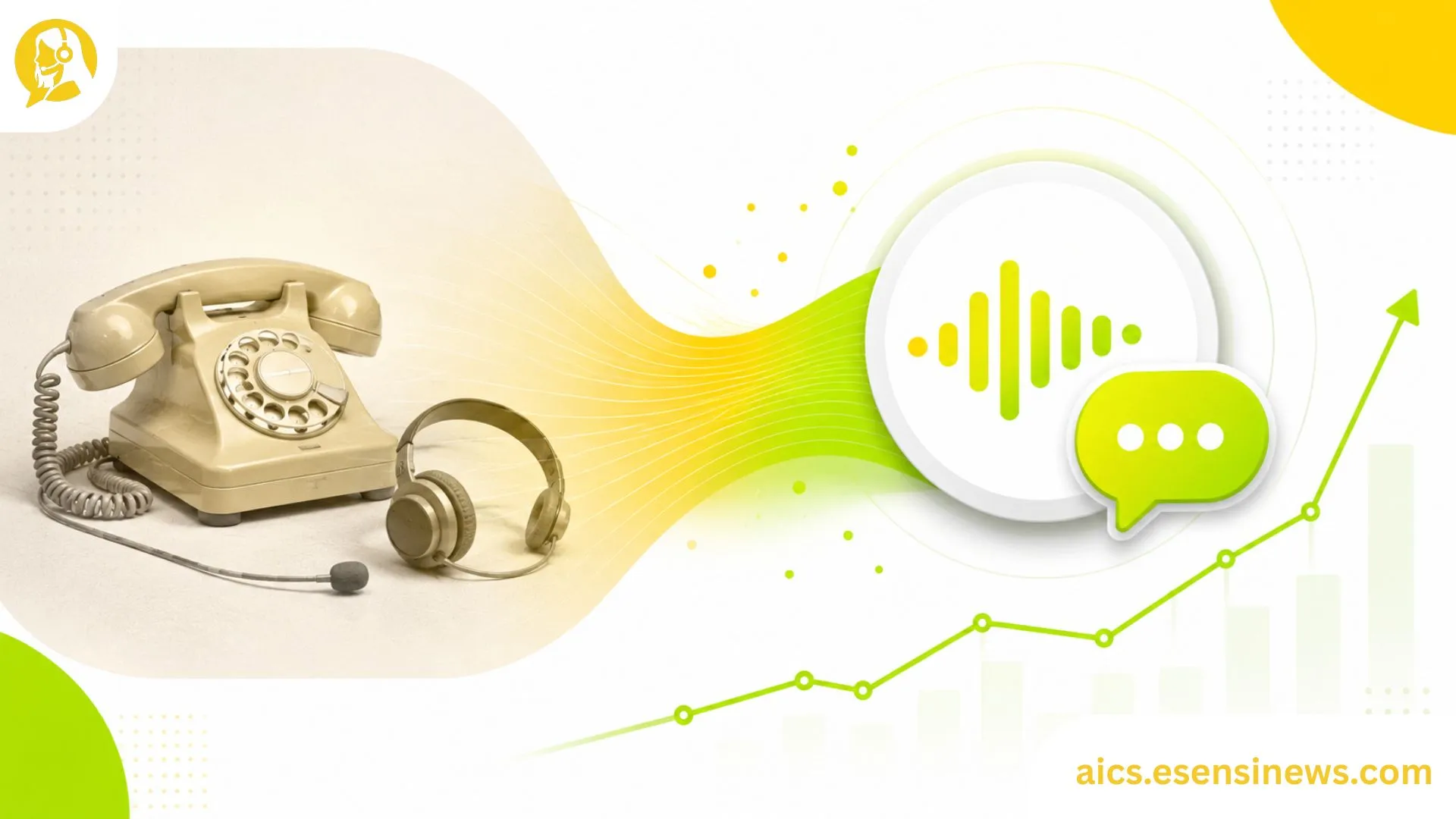
Call centers have quietly become one of the busiest testing grounds for AI in call center operations, and the shift isn’t subtle anymore. What used to mean long hold music and repeating your account number three times is turning into instant routing, predictive answers, and agents who actually have context before they say hello. This isn’t hype dressed up as innovation it’s a measurable change in how businesses handle customer demand without adding headcount every quarter.
I’ve spent years watching support teams adopt these tools, and honestly, the rollout is rarely flashy. It’s incremental. But the compounding effect on efficiency and customer satisfaction is hard to argue with once you see the numbers.
The Evolution of Call Center Technology
Go back 25 years and a “call center” meant rows of headsets and a wall-mounted whiteboard tracking call queues. Then came IVR systems in the late ’90s “press 1 for billing, press 2 for support” which solved routing but frustrated practically everyone stuck in a menu loop.
From IVR to Conversational AI
The next leap wasn’t really about menus at all. It was about letting customers just talk, type, or ask in plain language and have the system understand intent instead of forcing them into rigid categories. That’s the backbone of where AI in call center technology sits today: natural language processing replacing button-mashing.
Benefits of Implementing AI in Call Centers
The case for AI in call center environments isn’t built on one flashy feature it’s a stack of smaller wins that add up.
Lower Wait Times
AI agents pick up instantly, with no queue. Even when a human handoff is needed, the AI has already gathered the context, so the live agent isn’t starting from zero.
Consistent Service Quality
A tired agent on hour seven of a shift might give a shorter, less patient answer than they would at hour one. AI doesn’t have an off day, which keeps the baseline quality steady across every interaction.
Scalable Support Capacity
Black Friday traffic, a product recall, a billing system outage call volume spikes happen, and hiring temp staff for a two-week surge is expensive and slow. AI scales instantly without a hiring pipeline.
Key AI Technologies Revolutionizing Call Centers
A handful of technologies are doing most of the heavy lifting behind the scenes.
| Technology | What It Does | Common Use Case |
|---|---|---|
| Natural Language Processing (NLP) | Understands customer intent from speech or text | Chat and voice query interpretation |
| Speech-to-Text & Voice Recognition | Converts spoken language into analyzable data | Call transcription, compliance logging |
| Predictive Routing | Matches callers to the best-fit agent or AI flow | Reducing transfer rates |
| Sentiment Analysis | Detects tone and frustration levels in real time | Escalation triggers |
| Generative AI Response Drafting | Suggests or auto-writes agent replies | Email and chat support |
Pricing for these capabilities varies a lot depending on whether you’re buying a bundled platform or stitching together point solutions bundled enterprise suites tend to run $150-$400 per agent seat monthly, while standalone analytics add-ons can be $20-$80 on top of an existing contact center license.
Enhancing Customer Experience with AI
Here’s an analogy that clicked for me the first time I explained this to a client: using an AI-routed call center is a bit like using GPS instead of stopping to ask a stranger for directions. You still might take a wrong turn occasionally, but on average, you get where you’re going faster, with less friction, and without bothering someone else to help you.
Customers don’t actually care whether AI or a human answered they care whether their problem got solved without three transfers and a 40-minute hold. A support manager on an industry forum put it bluntly:
“Nobody loves the bot, but nobody loved the hold music either. They just love getting an answer.”
That’s really the bar AI in call center deployments needs to clear: not “more impressive,” just “less annoying.”
AI-Powered Analytics for Improved Performance
This is where the ad-friendly, business-case part of the conversation lives, because analytics is usually what justifies the spend to leadership.
| Metric | Before AI Analytics | After AI Analytics |
|---|---|---|
| Time to identify recurring issue trends | 2-3 weeks (manual review) | Real-time to 24 hours |
| Agent coaching frequency | Monthly | Weekly, data-triggered |
| Forecast accuracy for staffing needs | 60-70% | 85-90% |
| Average CSAT improvement after 6 months | +8-12% |
If you’re shopping for a premium analytics layer, look closely at whether the platform offers predictive staffing forecasts that single feature alone tends to pay for itself by preventing both overstaffing during slow periods and understaffing during spikes. You can compare detailed breakdowns of analytics-focused platforms and pricing on this AI call center solutions overview before committing to a vendor demo.
Challenges of Integrating AI in Call Centers
It’s not all upside, and pretending otherwise would be a disservice.
Advantages
- Significant reductions in repetitive ticket volume
- New agents can get up to speed faster with AI-assisted prompts and recommendations
- Customer support teams gain better visibility into recurring pain points and common issues
- Organizations can lower the cost per resolved ticket as operations scale
Challenges
- Initial data migration and CRM integration can be complex and time-consuming
- Sentiment analysis models still struggle with sarcasm, regional accents, and code-switching
- During high-stakes interactions, such as billing disputes or cancellation requests, many customers prefer immediate access to a human agent
- Accuracy can decline over time, making ongoing model monitoring and retraining essential
For me personally, the biggest implementation mistake I’ve seen isn’t a tech failure it’s businesses assuming AI is “set and forget.” It’s closer to hiring a new employee who needs ongoing coaching, except the coaching happens through data instead of a 1-on-1 meeting.
Future Trends in AI and Call Center Operations
A few directions are becoming clearer as the technology matures. Proactive outreach where AI flags a likely issue (a delayed shipment, an upcoming renewal) and contacts the customer before they call in frustrated is moving from pilot programs into standard offerings. Voice AI is also getting noticeably better at handling multi-turn conversations without losing context, which used to be a major weak point just two or three years ago.
There’s growing interest in hybrid models too, where AI handles the first 80% of a conversation and a human closes out the emotionally sensitive 20%. For more on where this is headed, the AI contact center technology hub tracks emerging tools and vendor updates as they roll out.
Case Studies: Successful AI Implementations in Call Centers
A regional telecom provider (kept anonymous here for confidentiality) implemented AI-driven triage for its technical support line, which historically handled a high volume of simple “is there an outage in my area” calls. After deployment, those inquiries dropped by roughly 35% as customers got instant outage-map answers through the AI agent instead of waiting on hold. By automating routine interactions, AI enabled agents to devote more time to complex installation and equipment troubleshooting calls, where human expertise and judgment were most valuable.
The same pattern emerged in healthcare scheduling. AI managed appointment confirmations and rescheduling requests, while staff concentrated on insurance-related concerns and care coordination issues—the types of conversations that still require empathy, context, and human understanding.
Frequently Asked Questions
What does AI in call center technology actually involve? It typically combines natural language processing, speech recognition, and automated routing to handle customer inquiries, with human agents stepping in for complex or sensitive issues.
Is AI in call center adoption only for large enterprises? No. Smaller teams can start with chat-based AI assistants or basic call routing tools before scaling into full voice AI and analytics suites as budget allows.
How accurate is AI sentiment detection during calls? Modern systems perform well on clear emotional cues but still misread sarcasm, heavy accents, and code-switching more often than vendors typically advertise.
Does adding AI reduce the need for human agents? It usually shifts agent focus rather than eliminating roles, with humans handling escalations and AI absorbing repetitive, high-volume inquiries.
What’s a realistic timeline to see ROI from AI call center tools? Most teams report measurable cost-per-ticket improvements within three to four months, with fuller gains by month six as the model learns from real conversation data.
The Future of Call Centers with AI
AI is transforming call center operations. Rather than replacing human support, it changes where agents focus their time and attention. AI handles high volumes and repetitive tasks efficiently. Human agents still manage complex situations that require empathy, judgment, and flexibility. Companies that view AI as an ongoing process often achieve more consistent long-term results.
If you want to evaluate the right approach for your business, explore different AI call center solutions. Compare features, pricing, and implementation requirements before choosing a vendor.
Last updated: June 2026


Leave a Reply