
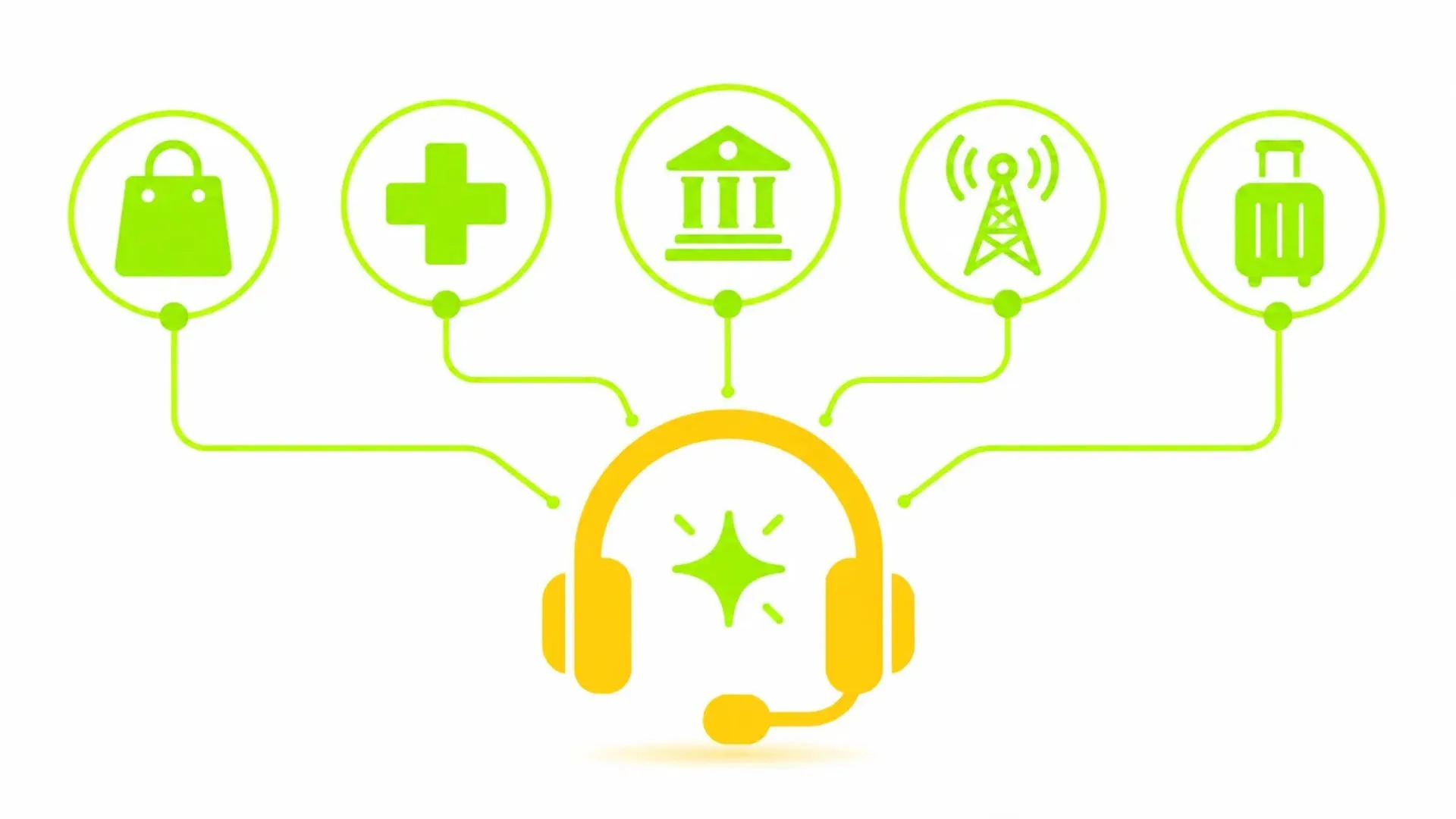
An AI call center looks pretty different depending on which industry you’re in. A retail brand handling order status calls during a holiday rush has very different needs than a healthcare provider managing appointment scheduling and insurance questions. Yet both can genuinely benefit from the same underlying technology, just applied in very different ways.
If you’re an operations leader trying to figure out where AI actually fits into your call center, generic feature lists only get you so far. What helps more is seeing how AI call center technology plays out in real industries, facing real constraints, with real results worth paying attention to.
This guide walks through five practical AI call center use cases across different industries, the capabilities that tend to show up across all of them, and what to keep in mind as you figure out where AI fits best for your own operation.
What Is an AI Call Center, in Plain Terms?
An AI call center uses artificial intelligence, like natural language processing and machine learning, to handle or assist with phone-based customer interactions. This can range from fully automated voice bots resolving simple requests, to AI quietly supporting human agents in the background during live calls.
The exact mix of automation versus human support tends to vary a lot by industry, largely based on call complexity, regulatory requirements, and how emotionally sensitive typical customer interactions tend to be.
AI Call Center Use Cases by Industry
1. E-Commerce and Retail
Retail call centers deal with high call volumes that spike unpredictably around sales events and holidays. AI call center tools here typically handle:
- Order status and tracking inquiries
- Return and exchange policy questions
- Basic product availability checks
Because these requests are usually straightforward and repetitive, retail tends to see some of the fastest, most measurable wins from AI call center adoption, often resolving a large share of calls without any human involvement at all.
2. Healthcare
Healthcare call centers face a trickier balance, since many calls involve sensitive personal information and require careful, accurate handling. AI here usually focuses on:
- Appointment scheduling and reminders
- Insurance verification questions
- Routing urgent calls to the right department quickly
Given the sensitivity involved, healthcare AI call center deployments usually keep human agents closely in the loop, using AI more as a support layer than a full replacement for sensitive conversations.
3. Financial Services and Banking
Banks and financial institutions deal with both high call volumes and strict compliance requirements. Common AI call center applications include:
- Balance inquiries and basic transaction history
- Fraud alert verification calls
- Routing complex disputes to specialized human agents
Compliance considerations mean financial services organizations tend to invest heavily in transparent escalation paths and detailed call documentation alongside their AI tools.
4. Telecom
Telecom providers often face extremely high call volumes around billing questions and technical troubleshooting. AI call center use cases here include:
- Basic troubleshooting walkthroughs for common connectivity issues
- Billing and plan inquiry handling
- Smart routing based on the specific technical issue described
Telecom is a strong example of where conversational, multi-turn AI really shines, since troubleshooting calls often require back-and-forth clarification before reaching a resolution.
5. Travel and Hospitality
Travel companies deal with urgent, time-sensitive calls, especially around flight changes, cancellations, or booking issues. AI call center tools commonly handle:
- Booking confirmations and itinerary questions
- Basic cancellation and rebooking requests
- Real-time flight or reservation status updates
Given how stressful travel disruptions can feel for customers, many travel companies pair AI with a fast, clearly visible path to a human agent for anything beyond routine requests.
Common AI Call Center Capabilities Across Industries
Regardless of industry, most AI call center deployments lean on a similar core set of capabilities:
- Natural language understanding to interpret what callers actually need, not just keyword matching
- Smart call routing based on intent rather than simple menu selections
- Real-time transcription for documentation, compliance, and quality review
- Sentiment detection to flag frustrated or urgent callers for faster human attention
- Post-call summaries that save agents from manual note-taking after every interaction
Think of these as the shared toolkit, while the specific use cases above show how that toolkit gets applied differently depending on what your callers actually need.
Pros and Cons of AI Call Centers Across Industries
Pros ✅
- Reduces wait times for routine, predictable requests
- Scales easily during seasonal or unpredictable volume spikes
- Improves consistency in information and tone across interactions
- Frees up agents for complex, high-value, or sensitive conversations
- Provides valuable data on common call patterns and pain points
Cons ❌
- Requires industry-specific tuning, since generic AI rarely performs well out of the box
- Compliance and sensitivity concerns demand careful human oversight in certain industries
- Voice accuracy can vary depending on accents, background noise, and call quality
- Needs ongoing maintenance as products, policies, and regulations evolve
- Risk of frustrating customers if escalation paths aren’t clear and easy to access
Practical Tips for Choosing AI Call Center Use Cases for Your Industry
- Start with your highest-volume, lowest-complexity call type. This is almost always the safest, most measurable starting point regardless of industry.
- Map your compliance requirements before automating anything. Regulated industries need extra care around what AI can and can’t handle independently.
- Look at how competitors in your industry are using AI. This can reveal realistic, proven use cases rather than starting from a blank slate.
- Pilot with a single use case before expanding. Even within retail or healthcare, different call types may need very different levels of automation.
- Revisit your use case list quarterly. What works well in month one may need adjusting as call patterns and customer expectations shift.
Common Mistakes Companies Make With AI Call Centers
- Applying a generic AI setup without tailoring it to industry-specific call patterns and compliance needs
- Automating sensitive interactions too early, before trust in the system is fully established
- Ignoring regulatory requirements specific to their industry during the rollout
- Failing to study how similar companies in their industry have approached AI, missing valuable lessons
- Treating one successful use case as a blueprint for everything else, without testing new use cases properly
FAQ: AI Call Center
1. What industries benefit most from an AI call center? Retail, healthcare, financial services, telecom, and travel all see strong results, though the specific use cases and level of automation vary by industry.
2. Is an AI call center suitable for healthcare, given privacy concerns? Yes, but healthcare deployments typically keep human agents closely involved for sensitive interactions and rely on AI mainly for scheduling and routing tasks.
3. How does an AI call center handle compliance in financial services? Most setups include detailed call documentation, transparent escalation paths, and strict data handling practices to support regulatory requirements.
4. Can a small business benefit from an AI call center? Yes. Many providers offer scalable solutions suitable for smaller call volumes, making AI call center technology accessible beyond large enterprises.
5. What’s the easiest AI call center use case to start with? High-volume, low-complexity requests like order status checks or appointment reminders are typically the safest and fastest starting points.
6. How long does it take to see results from AI call center adoption? Many companies see measurable improvements in handle time and resolution rates within the first few months of a well-planned rollout.
7. Does an AI call center replace human agents entirely? No, most AI call centers handle routine requests while human agents continue managing complex, sensitive, or emotionally charged conversations.
Conclusion
An AI call center isn’t a one-size-fits-all solution, it looks and performs differently depending on your industry’s specific call patterns, compliance needs, and customer expectations. From retail’s high-volume order inquiries to healthcare’s careful balance of automation and human oversight, the right approach always comes down to matching AI capabilities to your actual use cases.
The takeaway? Look at how your industry peers are using AI, start with your highest-volume and lowest-risk call type, and expand gradually from there. That’s how an AI call center becomes a genuine asset instead of just another piece of software collecting dust.
Ready to Find Your Industry’s Best Use Case?
If this guide gave you a clearer starting point, take a look at your own call volume data and match it against the use cases above to find your best entry point. Know another operations leader exploring AI call center options in your industry? Pass this along to them. And if you’re planning to dig deeper into AI-driven call center strategies, bookmark this page so it’s easy to find again. Here’s to finding the use case that actually moves the needle for your team.


Leave a Reply