
Picture this: your support queue hits 3,000 tickets on Black Friday. Your team of 15 agents is already maxed out by noon. Response times balloon to 6 hours. One-star reviews start trickling in by 3 PM.
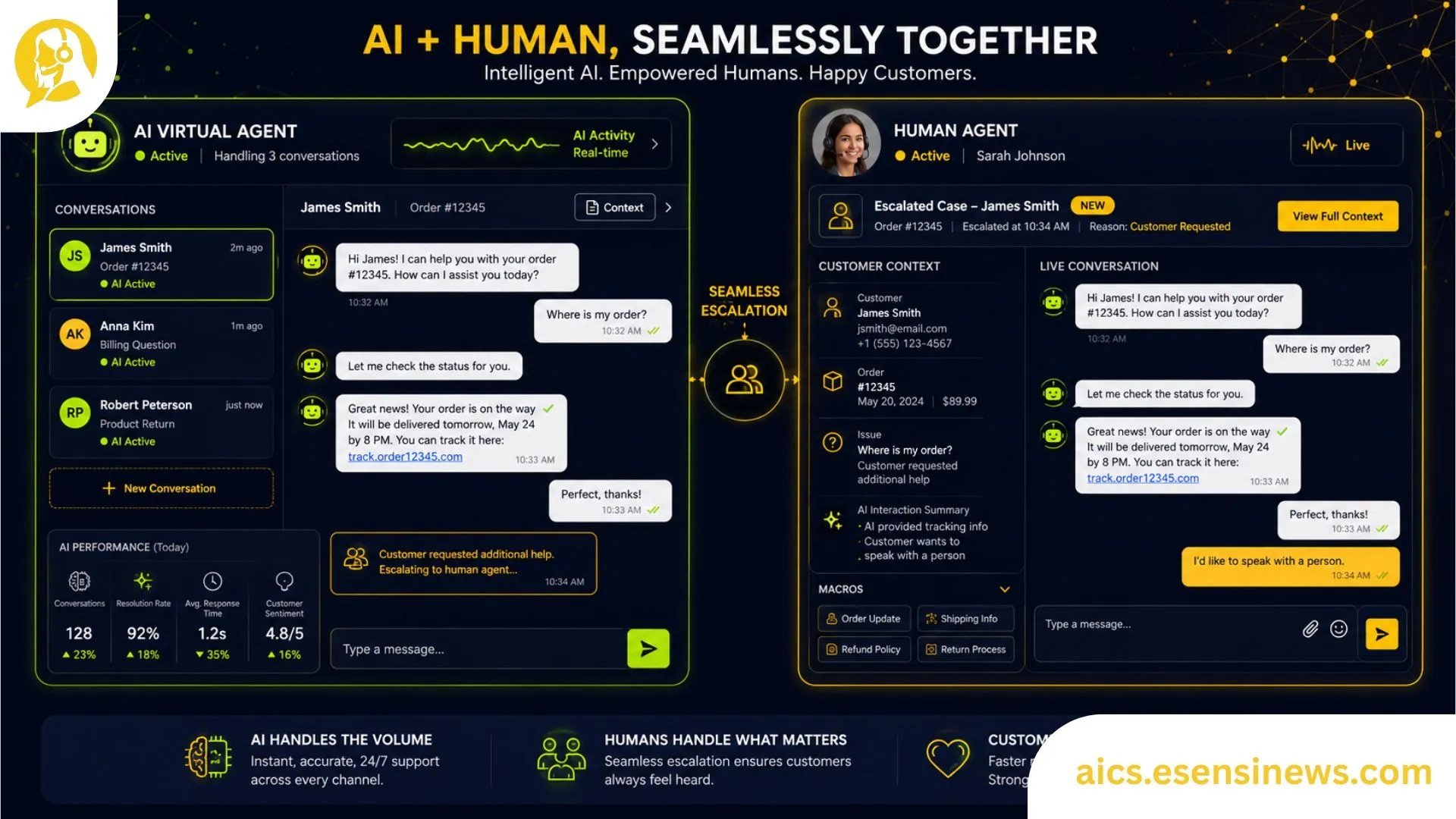
Now picture the same scenario except an AI customer service agent handles the first 70% of that volume instantly, routes the complex stuff to your human team with full context attached, and never once puts a customer on hold because it “needs to check with a colleague.”
That’s not a fantasy pitch. Companies running mature AI support deployments are seeing exactly these kinds of numbers. But getting there? It takes more than buying a subscription and flipping a switch. In my experience working with support teams across e-commerce, SaaS, and financial services, the difference between a chatbot that helps and one that infuriates comes down to how it’s built, trained, and managed over time.
Let’s get into what actually works and what to watch out for.
The Evolution of Customer Service Technology
From Scripts to Intelligence
Customer service has always been about speed and accuracy. The tools changed; the core need didn’t.
In the 1990s, IVR systems (those “press 1 for billing” phone trees) were the big efficiency play. They worked technically. Customers tolerated them the way you tolerate a slow Wi-Fi connection. It’s functional. Nobody’s happy about it.
Live chat arrived in the early 2000s and felt genuinely better. One agent handling three conversations simultaneously instead of one phone call was a real productivity gain. But it still scaled linearly: more volume meant more headcount, and headcount is expensive.
Rule-based chatbots followed around 2014–2016. These were essentially IVR reimagined as text boxes. Decision trees. Keyword matching. If a customer typed something the bot didn’t recognize, it’d loop back to the main menu like a confused golden retriever. Frustrating but cheap to deploy.
The NLP Shift That Changed Everything
The real inflection point came around 2019–2020, when transformer-based NLP models think BERT, then GPT variants matured enough for production use. Suddenly, AI agents could understand intent rather than just matching keywords. “My payment didn’t go through” and “I keep getting an error when I try to check out” both trigger the same resolution flow, even though the words share nothing in common.
That capability shift is what created the modern AI customer service agent. Not a bot. Not a FAQ lookup tool. An agent something that can understand context, pull live data, take action, and hand off intelligently when it hits a wall.
According to Gartner, AI-augmented customer service interactions are expected to account for over 60% of total support volume by 2026. That number was projecting aggressive growth when first published. Looking at current adoption rates, it might actually be conservative.
The AI Contact Center landscape has evolved accordingly from simple deflection tools to full-stack agents capable of handling multi-step resolution workflows end to end.
Benefits of AI Customer Service Agents
Speed That’s Hard to Argue With
Human agents even fast ones need a few seconds to pull up an account, a few more to read the history, and a moment to formulate a response. An AI agent does all of that in under a second, every time, simultaneously for hundreds of conversations.
A 2023 Salesforce report found that AI-assisted support teams resolve issues 40% faster on average than those working without AI tools. For customers, that’s the difference between a 2-minute resolution and an 8-minute one. Small individually; massive at scale.
Cost Reduction With Real Numbers
Let’s do quick math. A mid-size company processing 8,000 support tickets per month at a fully-loaded agent cost of $9/ticket is spending $72,000/month on support. Deploy an AI agent that handles 50% of tickets at $0.60/interaction, and you’re looking at $27,600 in savings every single month. That’s before accounting for reduced overtime, lower turnover from reduced agent burnout, and faster resolution improving LTV.
IBM has reported that organizations using AI in customer service operations see an average cost reduction of 30%. Drift puts average deflection rates between 40–70% for well-implemented AI agent deployments.
Consistency at Scale
Here’s something nobody talks about enough: human agents give different answers. Not because they’re incompetent because they’re human. They interpret policy differently, they’re more lenient on bad days, they make exceptions based on gut feel. Sometimes that’s fine. Sometimes it creates legal exposure or brand inconsistency.
An AI customer service agent delivers the same answer to the same question at 2 AM on a Tuesday as it does at 11 AM on a Monday. For regulated industries finance, healthcare, insurance that consistency isn’t just operationally nice. It’s compliance-critical.
24/7 Without the Overtime Bill
Nearly half of customer service interactions happen outside standard business hours, according to Intercom’s 2023 Customer Support Benchmarks report. Running a full overnight team is expensive. Running a skeleton crew means slower responses when a customer’s card gets declined at midnight.
An AI agent is the overnight team at a fraction of the cost, without holiday pay complications.
Key Features of AI Customer Service Solutions
Not all AI agents are built the same. The gap between a $29/month SMB tool and a $100K enterprise deployment isn’t just marketing it reflects real differences in capability. Here’s what to actually look for.
Natural Language Understanding Quality
This is the foundation. If the NLU layer can’t accurately detect intent from messy, real-world input (“ugh my thing stopped working again why”), nothing else matters. Evaluate this with your own actual ticket data during any vendor trial don’t let them demo on curated examples.
Action Capability (Not Just Answers)
The best AI customer service agents don’t just respond they act. That means processing refunds, updating account information, canceling subscriptions, scheduling callbacks. An agent that can only answer questions is a sophisticated FAQ. Actual resolution requires integration with your backend systems.
Graceful Human Handoff
Non-negotiable. An AI agent will hit situations it can’t handle emotionally charged complaints, edge cases outside its training, multi-step issues requiring human judgment. The handoff to a human agent must be smooth: full conversation transcript included, customer not required to repeat themselves. Anything less tanks CSAT.
Sentiment Detection and Escalation Logic
Advanced platforms analyze emotional tone throughout the conversation. When frustration spikes “THIS IS THE THIRD TIME I’VE CALLED” the system should automatically flag for priority escalation or route to a senior human agent. This prevents small issues from becoming public social media complaints.
Analytics Dashboard You’ll Actually Use
Resolution rate. Deflection rate. Average handling time. CSAT by channel. Top intents by volume. Drop-off points in conversation flows. If your vendor can’t surface these metrics easily, you’re managing blind.
Platform Comparison: Leading AI Customer Service Agent Solutions (2024)
| Platform | Starting Price | NLU Quality | Action Capability | Best For |
|---|---|---|---|---|
| Intercom Fin | $39/seat + usage fees | ★★★★★ | High (integrations) | SaaS, tech companies |
| Zendesk AI | $55/agent/month | ★★★★☆ | High | Mid-market, enterprise |
| Salesforce Einstein | Custom pricing | ★★★★★ | Very High (native CRM) | Enterprise |
| Freshdesk Freddy | $29/agent/month | ★★★★☆ | Medium | SMBs |
| Ada Support | Custom pricing | ★★★★☆ | High | E-commerce, SaaS |
| Tidio AI | $19/month | ★★★☆☆ | Low–Medium | Small business, stores |
Pricing as of Q2 2024. Verify directly with vendors especially enterprise tiers, which often require custom quotes.
Real-World Applications of AI in Customer Support
E-Commerce: Order and Returns Automation
A major apparel retailer one you’d recognize was handling 14,000 tickets/month, with roughly 38% related to order status and returns. They deployed an AI agent integrated directly with their order management system.
After 60 days:
- 72% of order/return inquiries resolved end-to-end by the AI agent
- Average resolution time: from 5.2 hours to under 3 minutes
- Human agent time freed up for complex complaints, fraud cases, and VIP customers
- Bot CSAT: 4.0/5 (versus 4.4/5 for human agents acceptable trade-off given the speed gain)
Financial Services: Account Inquiries and Fraud Response
Speed is everything in financial services support. A fraud victim waiting 40 minutes to freeze their card is a nightmare scenario for the customer and for the institution’s liability exposure.
Regional banks deploying AI customer service agents for card freeze requests and balance inquiries have reduced time-to-resolution for high-urgency cases from 25+ minutes to under 60 seconds. The AI handles identity verification, pulls the account, and executes the freeze autonomously, at any hour.
SaaS: Onboarding and Technical Tier-1
For SaaS companies, the support burden peaks in the first 30 days of a customer’s lifecycle. New users asking the same 12 questions about setup, integrations, and billing account for a disproportionate share of ticket volume.
AI agents trained on product documentation can handle this tier-1 load effectively, freeing support engineers for actual bugs and complex configuration issues. Resources like AICS document real SaaS deployments in detail worth reading before scoping your own implementation.
Comparing AI Customer Service Agents to Human Agents
This comparison makes some support leaders uncomfortable, because the temptation to frame it as “AI vs. jobs” is real. That’s the wrong frame. The more useful question: what does each do well?
| Capability | AI Customer Service Agent | Human Agent |
|---|---|---|
| Response Speed | Instant (sub-second) | 30 seconds to several minutes |
| Availability | 24/7, no holidays | Shift-dependent |
| Consistency | Perfect same answer every time | Variable |
| Volume Handling | Unlimited simultaneous conversations | 3–5 max concurrently |
| Emotional Intelligence | Limited (sentiment detection only) | High |
| Complex Problem Solving | Low–Medium depending on training | High |
| Cost Per Interaction | $0.30–$1.50 | $5–$15 (fully loaded) |
| Learning Speed | Fast (model updates) | Variable (individual training) |
| Language Support | Strong (major languages) | Limited by staff diversity |
The takeaway: AI agents win on speed, scale, consistency, and cost for tier-1 volume. Human agents win on nuance, empathy, and genuinely complex cases. The smart play is running them together, not choosing one over the other.
Challenges and Limitations of AI in Customer Service
Let’s be real about what these systems can’t do because every vendor demo you see will show the tool at its absolute best, not at 2 AM handling a furious customer in broken English who’s been transferred three times already.
Hallucination Risk With Generative AI
LLM-powered agents can generate confident, fluent, completely wrong answers. This is called hallucination, and it’s a genuine risk in customer-facing deployments. The best vendors are building guardrails limiting generative responses to vetted content, adding confidence thresholds, routing low-confidence queries to humans. But it’s not a solved problem. Ask any vendor specifically how they handle hallucination before signing anything.
Training Data Quality
An AI agent is only as good as the data it’s trained on. Build intent models from generic templates instead of your actual ticket data, and accuracy suffers. I’ve seen deployments where the agent misclassifies 30% of intents because the training set was built from hypothetical scenarios rather than real historical conversations.
Emotional Complexity Is Still a Human Domain
Sentiment detection is improving. But there’s a meaningful gap between detecting that someone is frustrated and actually handling that frustration well. An AI agent that correctly identifies an angry customer and immediately escalates is doing its job. One that tries to reason with an emotionally charged complaint using templated empathy language (“I understand how frustrating this must be for you!”) often makes things worse.
Integration Complexity
The action-capable AI agents the ones that can actually do things, not just answer questions require integration with your CRM, helpdesk, OMS, payment processor, and whatever else powers your backend. That integration work is where deployments get delayed and costs balloon. Budget for it.
Ongoing Maintenance Is Real
Models drift. Products change. Policies update. A chatbot trained on last year’s return policy confidently gives wrong answers about this year’s. Plan for quarterly audits at minimum, and designate someone internally to own the AI agent’s ongoing performance.
Pro & Cons of AI Customer Service Agents
✅ Pros
- Handles high ticket volume without adding headcount
- Available 24/7 including weekends and holidays
- Consistent policy enforcement across every interaction
- Resolves tier-1 issues in seconds instead of hours
- Generates analytics that surface systemic support issues
- Scales instantly during traffic spikes and peak seasons
- Reduces agent burnout by offloading repetitive queries
❌ Cons
- Enterprise setup costs can reach $50,000–$200,000+
- Requires 3–6 months for a production-ready deployment
- Hallucination risk with LLM-based response generation
- Poor handling of emotionally complex or highly nuanced cases
- Integration with legacy systems can be technically painful
- Needs ongoing training and maintenance not “set and forget”
- Multilingual quality varies significantly across platforms
Future Trends in AI Customer Support
Agentic AI: From Answering to Acting
The next wave isn’t chatbots that respond it’s agents that complete multi-step workflows autonomously. A customer calls about a billing dispute: the AI agent pulls the account, reviews the last three invoices, identifies the discrepancy, issues a partial credit, sends a confirmation email, and logs the interaction in the CRM. No human involved unless the case is flagged as unusual.
This is already happening at the enterprise level. By 2026–2027, it’ll be standard at mid-market.
Voice AI Getting Genuinely Good
Phone support isn’t dead it’s evolving. AI voice agents from Google (CCAI), Amazon (Lex), and Nuance are getting accurate enough that customers sometimes don’t realize they’re talking to a machine. Juniper Research estimates voice chatbots will handle over 8 billion interactions annually by 2026. The channel isn’t going away; it’s just changing who (or what) answers.
Proactive Support
The most sophisticated next step isn’t reactive AI it’s AI that prevents support tickets from being created. Systems that monitor product usage, detect friction patterns (a user clicking the same button repeatedly is a signal), and proactively reach out with help before the customer gets frustrated enough to contact support. Early movers are already seeing measurable reductions in ticket volume from proactive intervention.
Hyper-Personalization at Scale
When an AI agent has full access to purchase history, browsing behavior, previous support interactions, and account tier, it can tailor every response to the individual customer not just their current issue but their relationship history with the brand. That’s a level of personalization human agents can rarely achieve under pressure.
How to Implement AI Customer Service Solutions
Step 1: Audit Your Ticket Data First
Before touching any vendor demo, pull 6 months of historical tickets. Categorize by intent. Identify your top 10 query types and what percentage of total volume they represent. If your top 5 intents account for 55%+ of tickets, you have a clear, high-ROI starting point for automation.
Step 2: Define What “Success” Looks Like
Pick your metrics upfront: deflection rate, resolution rate, average handling time, CSAT. Without a baseline and a target, you won’t know if the deployment is working.
Step 3: Choose the Right Platform for Your Scale
Don’t overbuy. A 500-ticket/month business doesn’t need Salesforce Einstein. A company handling 50,000 tickets/month probably shouldn’t be using a $19/month SMB tool. Match platform capability to current volume with room to grow.
Step 4: Integrate With Your Backend Systems
This is where real value gets unlocked. An AI agent that can pull live order data, update account records, and process requests in real time is dramatically more valuable than one that can only retrieve knowledge base articles. Invest in integration work upfront.
Step 5: Train on Real Data, Pilot Carefully
Build your intent models from actual historical tickets. Run a soft launch 10–20% of traffic before full deployment. Monitor resolution rate and CSAT weekly during the first 90 days. Fix before you scale.
Step 6: Build a Feedback Loop
Every “that didn’t help” click, every escalation to a human agent, every low CSAT rating is information. Build processes to capture and act on that feedback monthly. The AI agents that improve over time are the ones with people actively reviewing performance data.
FAQ: AI Customer Service Agents
Q1: What’s the difference between an AI customer service agent and a regular chatbot?
A traditional chatbot follows a predefined decision tree it matches keywords and delivers scripted responses. An AI customer service agent uses NLP to understand intent from natural language, can handle ambiguous or unusual phrasing, learns from interactions over time, and can take actual actions (process refunds, update records, schedule callbacks) rather than just answer questions. Think of a chatbot as a vending machine and an AI agent as a knowledgeable colleague one dispenses fixed options, the other actually helps you solve something.
Q2: How much does implementing an AI customer service agent cost?
Costs vary significantly by scale and complexity. SMB tools like Tidio start at $19–$49/month and suit basic FAQ automation. Mid-market platforms (Freshdesk, Intercom) run $29–$100/agent/month plus potential usage fees. Enterprise deployments with deep CRM integration and custom NLU training can run $50,000–$250,000 for initial setup, with ongoing licensing and maintenance on top. ROI calculation should weigh ticket deflection savings against total cost of ownership over 24 months.
Q3: Will AI agents hurt customer satisfaction scores?
Only if implemented poorly. Research from Salesforce shows well-deployed AI tools can improve CSAT by 10–15% by dramatically cutting wait times and delivering instant, accurate responses. The variable that determines whether AI helps or hurts CSAT is resolution rate if the agent solves the problem, customers don’t care whether it was human or machine. If it deflects, confuses, or loops, scores tank fast.
Q4: How long does it realistically take to deploy an AI customer service agent?
Production-ready deployments typically take 3–5 months from contract signing to full rollout. That includes platform selection, backend integration, conversation flow design, NLU training on historical data, QA testing, soft launch with limited traffic, and full deployment. Vendors promising “live in 48 hours” are selling templated FAQ widgets, not real AI agent deployments. Budget your timeline accordingly.
Building a Support Operation That Actually Scales
Here’s the bottom line on AI customer service agents: they’re not a shortcut, and they’re not magic. They’re powerful infrastructure the kind that requires real investment to set up correctly, but pays dividends for years once it’s running well.
The companies getting outsized returns from this technology share a pattern. The most successful deployments begin with real customer data instead of polished vendor demos. Strong integration practices help ensure reliable performance from day one. Long-term success depends on treating the AI agent as an evolving system rather than a one-time investment.
And they never try to hide the fact that it’s AI customers are fine with bots when bots actually solve their problems.
If your support operation is struggling to scale, or you’re watching costs climb faster than ticket volume justifies, AI agents are worth a serious look. The math generally works. The technology is mature enough. The risk now isn’t whether AI can handle your tier-1 volume it’s whether you implement it thoughtfully enough to capture that value.
Start with your top-5 intents. Build a focused pilot. Measure obsessively. Then expand.
For deeper dives into AI contact center implementations, real case studies, and platform-specific guidance, the team at AICS has done the legwork — from deployment strategy to ongoing optimization frameworks. Worth bookmarking if this is a decision you’re making in the next quarter.
This article reflects information current as of June 2026. Platform pricing and features change frequently always verify directly with vendors before making purchasing decisions.


Leave a Reply