
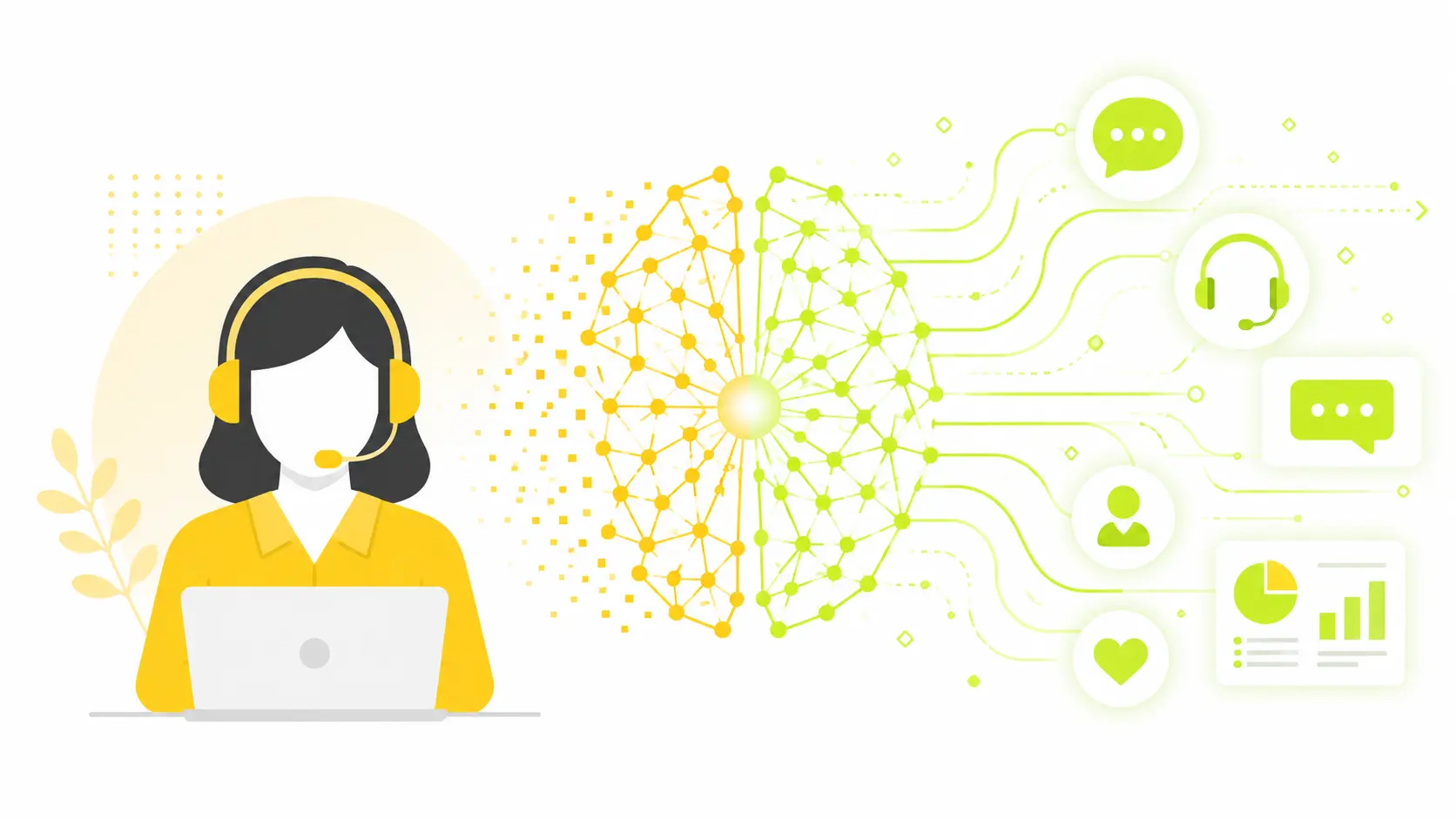
Here’s a question worth sitting with before you buy anything: what does your contact center actually cost per interaction, and how much of that cost goes toward conversations a machine could have handled just as well? For operations leaders evaluating an artificial intelligence contact center upgrade, that question is the right starting point.
Most operations leaders can’t answer that precisely. And that vagueness that gap between what’s known and what’s measured is exactly where artificial intelligence contact center technology creates its clearest value. Not by replacing people wholesale, but by making it possible to see, for the first time, which contacts genuinely need a human and which ones have been consuming human attention because there was nothing else to handle them.
I’ve watched this market shift considerably over the past few years, and in 2026 the deployments that work aren’t theoretical. They’re measured, documented, and increasingly replicable. This guide is about what that actually looks like.
Last updated: June 2026.
The Evolution of Customer Service Technology
Customer service technology has gone through roughly three generations, each defined by what it could do and what it couldn’t.
The first generation was the phone queue: humans, headsets, and a hold tone. Fast to deploy, expensive to scale, and completely dependent on staffing levels that could never quite match demand. The second generation brought automated IVR systems in the 1990s and early 2000s press 1, press 2, try not to yell at a recording. Useful for offloading the most predictable contacts, but limited by rigid decision trees that broke the moment a customer said anything unexpected.
The third generation is artificial intelligence contact center technology, and what separates it from both predecessors is adaptability. Instead of following a preset path, an AI can understand intent expressed in natural language, pull context from account history, and generate a response that fits the actual situation not just the closest matching menu option. Gartner’s 2025 customer service technology report projected that AI would manage the majority of customer interactions in some form by 2027, a trajectory that would have seemed implausible just five years ago.
The shift isn’t just technical. It’s operational. Businesses that previously had to staff for peak volume and accept waste during off-peak periods now have a layer that scales automatically in both directions.
Key Benefits of Implementing AI in Contact Centers
The case for artificial intelligence contact center technology is well past the “it sounds promising” stage. Here’s what shows up in practice, consistently, across industries that have enough deployment history to have real data:
- Significant cost reduction per contact. Deloitte’s 2025 global contact center survey found that organizations running mature artificial intelligence contact center deployments defined as 18+ months in operation reported cost per contact reductions of 28-42% compared to pre-AI baselines.
- Higher first-contact resolution. When AI handles context retrieval and response generation accurately, contacts don’t bounce back into the queue for follow-up. FCR rates improve because agents human or virtual start with full information instead of starting from zero.
- After-hours coverage without after-hours costs. An AI layer doesn’t charge a night shift differential or call out sick during a holiday weekend.
- 100% quality monitoring. Traditional QA reviewed 3-5% of contacts. An artificial intelligence contact center platform scores every single one flagging compliance misses, tone problems, and coaching opportunities that manual sampling routinely missed.
- Faster onboarding for new agents. Agent-assist tools that surface relevant knowledge in real time during live calls cut the ramp time for new hires from months to weeks in several documented deployments.
Worth noting: these benefits don’t appear all at once. Early-stage deployments (under six months) typically show the fastest gains on deflection rate and cost per contact. Agent satisfaction and QA depth tend to improve more gradually, over 12-18 months.
Types of AI Technologies Used in Customer Service
“Artificial intelligence” covers a lot of ground. Understanding which specific technologies drive which outcomes helps during vendor evaluation when every platform claims to be “AI-powered,” the details matter more than the label.
| AI Technology | Primary Function | Maturity Level in 2026 | Where It Works Best |
|---|---|---|---|
| Natural Language Understanding (NLU) | Interprets customer intent from text or speech | Mature, widely deployed | Chatbots, voice bots, email routing |
| Large Language Models (LLM) with RAG | Generates accurate, context-grounded responses | Rapidly maturing | Complex query resolution, agent assist |
| Automatic Speech Recognition (ASR) | Converts voice to text in real time | Mature, improving on accents/noise | Call transcription, voice bots |
| Sentiment & Emotion Analysis | Detects customer frustration or urgency | Mid-stage adoption | Escalation triggers, real-time QA |
| Predictive Analytics | Forecasts volume, churn risk, agent load | Mature in analytics, newer in live routing | Workforce management, proactive outreach |
| Generative AI (Summaries, Drafts) | Produces post-call summaries, response drafts | Early-mid stage adoption | Agent assist, documentation automation |
The most effective artificial intelligence contact center deployments in 2026 combine three or more of these layers rather than treating them as standalone features NLU for understanding, RAG-grounded LLMs for accurate responses, and sentiment analysis for escalation signals, all feeding into the same customer profile.
Enhancing Customer Experience with AI Solutions
Let’s be real about something: AI doesn’t guarantee a better customer experience. Deployed poorly, it actively makes things worse. The businesses that improve their CSAT with artificial intelligence contact center technology have one thing in common they obsessed over the experience design, not just the technology.
The Personalization Advantage
When an AI pulls full account history before generating a response not just a customer name, but prior contacts, unresolved tickets, recent purchases, and communication preferences the interaction feels noticeably different to the customer. They don’t have to re-explain context. They don’t feel like a ticket number. That sense of being known, even in an automated interaction, consistently moves satisfaction scores.
The Handoff Problem (and How to Solve It)
The single most common artificial intelligence contact center failure point isn’t the AI itself it’s what happens when the AI reaches its limits and passes the conversation to a human agent. If that handoff means the customer starts over from scratch, the goodwill from a fast initial response evaporates instantly.
The fix is architectural, not technological: design the handoff so that the agent receives a real-time summary of the AI conversation, flagged intent, and any customer sentiment signals before they say their first word. That’s a workflow decision, not an AI model decision, and it’s the one that most directly predicts whether customers rate the AI-assisted experience positively or negatively.
“We ran a two-month test comparing handoffs with and without a pre-populated agent summary. CSAT on calls with the summary was 22 points higher. Same agents, same AI, completely different experience design,” shared a CX product lead at a contact center technology firm in a 2025 industry panel organized by the Customer Experience Professionals Association.
Challenges and Considerations in AI Implementation
✅ What Works Reliably When Done Right
- Deflecting repetitive tier-1 contacts from human agents typically reaching 60-75% within the first quarter of a focused deployment
- Reducing average handle time through real-time agent assist, with documented improvements of 15-28% across industries
- Delivering consistent compliance language across 100% of contacts, not the 3-5% that human QA reviewed
- Generating structured interaction data that product, ops, and marketing teams can actually use downstream
❌ Where Implementations Consistently Stumble
- Legacy telephony and CRM integration taking two to four times longer than vendor estimates, especially for businesses on older on-premise systems
- AI accuracy degrading after three to six months without active model retraining as products, policies, and pricing change
- Agent resistance driven by poor communication teams that aren’t told clearly what the AI handles (and what it won’t replace) tend to quietly undermine adoption
- Demographic mismatch: older customers and enterprise B2B accounts with long-term relationship expectations often prefer human contact, even for simple requests, and forcing them through an AI layer generates friction rather than satisfaction
There’s also an ongoing data governance dimension that catches organizations off guard. An artificial intelligence contact center system ingests a significant volume of customer PII across every interaction. Before go-live, your legal, security, and compliance teams need to review data residency options, retention policies, and whether call transcripts are used to train shared models not as an afterthought, but as a hard prerequisite.
Successful AI Integration in Contact Centers
Three deployments from different industries, paraphrased from publicly reported outcomes rather than vendor marketing materials:
A national pharmacy chain integrated artificial intelligence contact center technology primarily to handle prescription refill inquiries and insurance verification questions contacts that made up roughly 55% of inbound call volume but required significant pharmacist and technician time to process manually. Within six months of deployment, roughly 78% of those contacts resolved through the AI layer without human involvement, and the freed staff time was redirected toward in-store patient consultations. Patient satisfaction scores for pharmacy contacts improved, and reported error rates on prescription-related information provided over the phone declined due to more consistent AI-delivered responses.
A regional property management company handling maintenance requests, lease questions, and payment inquiries across a portfolio of residential properties used AI to provide 24/7 coverage for tenant contacts. Before deployment, after-hours contacts went unanswered until the next business day, generating significant frustration among tenants. Post-deployment, the company reported a 40% reduction in complaint escalations to property managers, largely because routine requests maintenance scheduling, payment confirmations were now resolved within minutes regardless of when they came in.
A large public university deployed an artificial intelligence contact center for its admissions and financial aid inquiry lines, which historically overwhelmed staff during application season (October through March). AI handled eligibility questions, document submission status, and deadline reminders, reducing the backlog that typically built up during peak periods and allowing admissions counselors to focus on complex financial aid cases and transfer student evaluations where human judgment was genuinely needed.
Same throughline as always: narrowly scoped, high-volume problem → fast, measurable outcome → expand from there.
AI’s Role in the Next Generation of Customer Service
A handful of shifts already in motion that will define what artificial intelligence contact center technology looks like in 2027 and beyond:
Agentic AI completing full transactions end-to-end. The current generation mostly answers questions. The next wave takes action processing a refund, modifying a subscription, rescheduling a delivery without routing to a human for the actual transaction. This is already live in limited enterprise deployments and moving toward mainstream availability.
Multimodal AI across channels. A single AI session handling a screenshot, a voice memo, and a follow-up text message without losing context between modalities is becoming standard on enterprise platforms, eliminating the channel friction that has always been a core complaint in omnichannel support.
Proactive AI outreach before customers contact you. Using predictive signals to reach customers before a problem becomes a complaint flagging a delayed shipment, notifying about an upcoming renewal that historically triggers cancellations, following up after a complex interaction to confirm resolution this proactive model measurably reduces inbound volume on the downstream contacts it prevents.
Domain-specific fine-tuned models replacing generic ones. Smaller models trained on a company’s own call transcripts and policy documents are outperforming large general-purpose models on narrow tasks at significantly lower inference cost. For organizations comparing artificial intelligence contact center platforms on long-term total cost of ownership, this trend changes the math on multi-year contracts.
For platform-specific updates and new capability announcements as they happen, our AI contact center resource hub tracks the market as it evolves.
Best Practices for Adopting AI in Your Contact Center
This is where planning separates the deployments that deliver from the ones that stall. From watching enough of both, here’s what actually makes the difference:
Start with a Contact Audit, Not a Demo
Before evaluating any vendor, pull 90 days of contact data and classify every interaction type by complexity and volume. Map out exactly which contacts are repetitive and structured enough for an artificial intelligence contact center layer to handle reliably versus which require genuine human judgment. That audit shapes your entire platform shortlist and sets realistic expectations for what automation can achieve and in what timeframe.
Scope the First Deployment Narrowly
The fastest ROI consistently comes from picking one or two high-volume, clearly defined contact types and deploying AI specifically for those, rather than trying to automate the full contact center in a single rollout. Get those use cases right, measure outcomes honestly, and expand from a foundation that’s proven to work.
Treat the Handoff as a Design Priority
As covered in the CX section above, how the AI transitions a conversation to a human agent has more impact on customer satisfaction than almost any other design decision. Build the handoff workflow before you build anything else.
Budget for Ongoing Maintenance
Model accuracy without active retraining degrades faster than most organizations expect. Assign specific ownership of knowledge base maintenance and retraining schedules before launch not after the first batch of outdated answers starts appearing in QA reviews.
Communicate the “Why” to Your Team
Agents who understand the purpose that AI is absorbing the repetitive, draining contacts so they can do more meaningful work adopt the tools and work with them productively. Agents who feel blindsided or threatened by the rollout don’t. Leadership communication is not a soft add-on to the deployment plan; it’s a direct input to your ROI timeline.
Key Questions Before You Commit
Before signing a contract with any artificial intelligence contact center vendor, get clear answers to these questions:
- How does escalation work? What exactly does the human agent receive at handoff real-time summary, full transcript, sentiment flags?
- Is model retraining included? How frequently, and at what cost when updates are needed?
- What are the data export terms? If you switch vendors in year two, what happens to your call transcripts and conversation data?
- What does integration with your stack look like? Get a written timeline estimate based on your actual CRM and telephony setup, not a generic reference case.
Mid-market deployments covering 15-50 agents typically run $2,000–$7,000/month for platform costs, plus $10,000–$40,000 in integration and setup depending on infrastructure complexity. Year-two costs drop significantly as the setup is fully amortized and the model starts delivering compounding accuracy gains from ongoing training on your own data.
Frequently Asked Questions
What exactly is an artificial intelligence contact center? It’s a contact center environment where AI technologies including natural language processing, machine learning, and speech recognition handle a portion of customer interactions autonomously, assist human agents in real time, or both. In a well-designed artificial intelligence contact center, the result is higher automation on routine contacts, improved agent efficiency, and structured data capture across every interaction.
How is AI in contact centers different from old-school IVR? Traditional IVR routes callers through preset menus based on keypad inputs and follows fixed decision paths that fail the moment a customer says something unexpected. Artificial intelligence contact center systems understand natural speech, handle complex intent, pull live account context, and adapt their responses based on what the customer actually says not just which button they pressed.
What are the most important metrics to track after implementing AI? Cost per contact, first-contact resolution rate, AI deflection rate (percentage of contacts resolved without human escalation), average handle time for agent-assisted contacts, and CSAT scores segmented by contact type. Tracking these before and after deployment is how you validate whether the AI is actually delivering and where it needs tuning.
Is artificial intelligence contact center technology suitable for small businesses? Small businesses can benefit, particularly from cloud-based entry-level platforms ($300–$1,200/month) that handle FAQ automation and basic routing. The ROI case strengthens considerably at higher contact volumes. Teams with fewer than 10 agents and low call volume may find the integration overhead outweighs the gains until they reach a meaningful scale threshold.
How do I avoid the most common AI contact center implementation mistakes? Three things: audit your contact types before buying anything, scope your first deployment to one or two use cases instead of the whole operation, and communicate clearly with your agents about what the AI does and doesn’t replace before it goes live. Most implementations that fail do so on one of these three points rather than on the technology itself.
The Future of Customer Service with AI
Artificial intelligence contact center technology is no longer a bet on where things are going it’s a description of where they already are for a growing share of support operations. The evidence is in the data: faster resolution, lower cost per contact, 100% QA coverage, and agents who spend their shifts on conversations that actually require human skill. That’s a different kind of contact center, and it’s the standard that customers are increasingly calibrating their expectations against.
Getting there isn’t about buying the most sophisticated platform. It’s about understanding your own operation well enough to deploy the right tool for the right use case, and building the internal processes to maintain and improve it over time. Start with the audit, scope the first deployment carefully, and invest in the handoff design. The rest follows from there.


Leave a Reply