
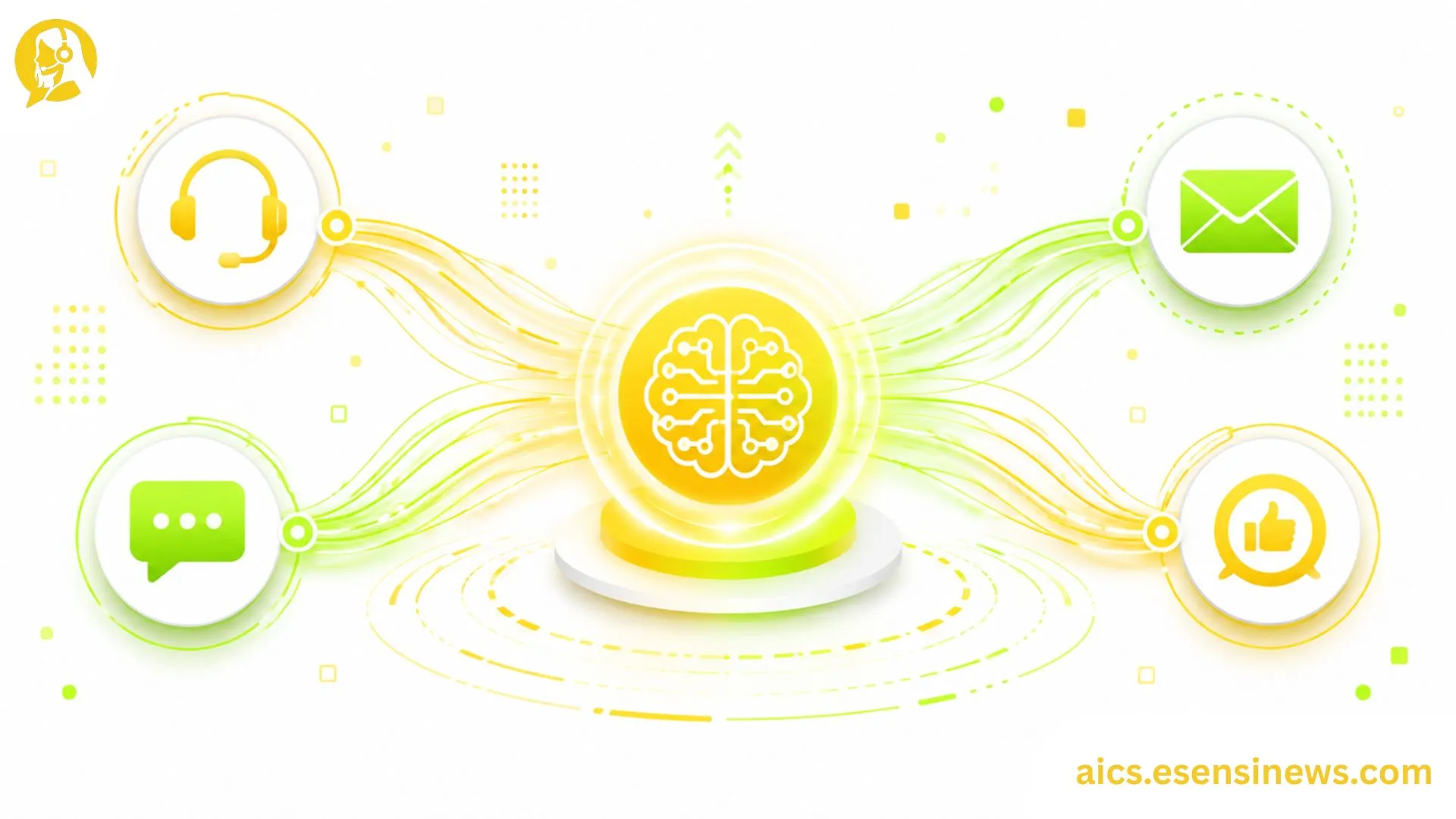
There’s a gap between what customers expect from support and what most contact centers actually deliver and it’s been getting wider, not narrower. Customers switch channels mid-conversation without thinking twice: they start on live chat, follow up by email, then call when neither resolved their issue. Traditional contact center setups treat each of those as a separate interaction. AI contact center solutions treat it as one continuous conversation.
That’s the core shift. And for businesses that handle significant support volume across voice, chat, email, social, or some combination of all four it’s the difference between a system that frustrates people and one that actually builds loyalty. I’ve spent years evaluating platforms across this space, and the results from well-implemented deployments are consistent enough now to make a clear case. Let’s get into what this actually looks like in practice.
Last updated: June 2026.
The Evolution of Customer Support Technology
Contact centers have been through several distinct eras, and each one felt transformative until the next one made it look dated. First came the phone queue a human, a script, a hold tone. Then came multichannel setups in the 2010s, where companies added email and chat as separate silos running on different platforms, managed by different teams, with no shared customer context between them. Customers noticed. They’d explain the same problem three times across three channels and wonder why the company didn’t know they’d already called twice.
The meaningful leap happened when AI matured enough to sit across all those channels simultaneously, maintaining a single thread of context regardless of where a customer showed up next. A 2025 Aberdeen Group research report noted that companies with AI-driven omnichannel contact center platforms achieved customer retention rates roughly 90% higher than companies running traditional multichannel setups a gap that reflects not just faster resolution, but the kind of experience that makes customers feel actually known rather than repeatedly processed.
It’s a bit like comparing a spiral-bound road atlas to a live navigation app. Both technically get you somewhere. Only one updates when the road conditions change mid-trip.
Key Features of AI Contact Center Solutions
The features that matter most in an AI contact center aren’t always the ones vendors lead with in demos. Here’s what actually drives outcomes, with honest context on who benefits from each.
Unified Omnichannel Context
Every channel voice, web chat, in-app messaging, email, and social feeds into a single customer profile that agents and AI alike can access mid-conversation. When someone switches from chat to a phone call, the agent already knows what the chatbot discussed, what the customer said, and what was already attempted. No “can you describe your issue again from the beginning.”
Conversational AI with Retrieval-Grounded Accuracy
The generation of AI contact center solutions worth evaluating in 2026 uses retrieval-augmented generation (RAG) meaning responses are pulled from your actual knowledge base, not hallucinated from training data. For businesses where accuracy matters (and it always matters), this distinction is significant. An AI that confidently cites the wrong return policy or a discontinued product price creates more damage than no AI at all.
Predictive Escalation Routing
Rather than routing based purely on what a customer says they need, modern platforms combine stated intent with sentiment analysis, account history, and predicted churn risk to match each contact to the most appropriate available resource. A high-value account flagged as at-risk doesn’t get routed to the general queue it gets escalated to a retention specialist, automatically.
Automated Post-Contact Workflows
After a call or chat ends, the AI handles the paperwork: summarizing the interaction, updating the CRM, tagging the ticket, and triggering any required follow-up actions. This alone typically saves agents 3-7 minutes per contact which compounds significantly across a full team over a month.
Benefits of Implementing AI in Customer Support
The benefits of AI contact center solutions fall into two categories: the ones that show up immediately and the ones that compound over time.
Immediate gains (within the first 90 days of a solid deployment):
- Automated handling of tier-1 contacts order status, password resets, basic account changes typically reaches 60-75% deflection from human agents within the first quarter
- Average speed to answer drops sharply when the AI handles routine volume, clearing human agent queues for complex issues
- QA coverage shifts from sampling 3-5% of contacts manually to reviewing 100% automatically
Compounding gains (6-18 months in):
- Agent coaching improves because managers have data on every interaction, not just the ones that happened to get sampled
- AI accuracy improves as the model ingests more of your company’s specific call and chat transcripts
- Customer data becomes richer and more structured, creating downstream value for product and marketing teams
Forrester’s 2025 customer experience benchmarking data estimated that mature AI contact center deployments meaning at least 12 months in reduced cost per contact by 30-45% compared to pre-AI baselines. That’s not a rounding error; that’s a structural cost change.
How AI Enhances Customer Experience
Real talk: AI doesn’t automatically improve customer experience. Badly configured AI the kind that traps callers in bot loops with no escape route actively destroys it. The difference between those two outcomes usually comes down to three design decisions.
Decision 1: How Fast and Clean Is Escalation?
The single biggest predictor of customer satisfaction in an AI-assisted contact center isn’t how smart the bot sounds it’s whether the handoff to a human feels fast and informed when it’s needed. Customers will forgive a bot that can’t resolve their issue. They won’t forgive having to explain the whole situation from scratch to the fourth person they’ve spoken with.
Decision 2: Does the AI Personalize, or Just Automate?
There’s a meaningful difference between an AI that answers a generic question and one that pulls up a customer’s history, acknowledges their tenure, and tailors its response to their account situation. The second one feels like service. The first one feels like a FAQ page that talks.
Decision 3: Is the Tone Adaptive?
Sentiment analysis that only flags frustration for review but doesn’t actually change how the AI responds in the moment misses half the value. The platforms worth deploying in 2026 adjust pacing, language complexity, and tone in real time based on detected stress in a customer’s voice or message patterns. An angry customer getting chipper, enthusiastic bot responses is a CSAT liability, not an asset.
“We spent six months optimizing our bot’s accuracy rate and saw modest CSAT gains. We spent two weeks redesigning the escalation flow and saw CSAT jump 14 points. The handoff is almost always the problem,” shared a VP of customer experience at a mid-sized SaaS company in a 2025 Customer Contact Week conference recap.
Common AI Technologies Used in Contact Centers
Understanding what’s actually under the hood helps you evaluate vendors more clearly, rather than taking “AI-powered” at face value.
| Technology | Function | Primary Use Case | What to Watch Out For |
|---|---|---|---|
| Natural Language Understanding (NLU) | Interprets customer intent from text or speech | Chat routing, voice IVR replacement | Accuracy with domain-specific terminology varies by platform |
| Large Language Models (LLMs) with RAG | Generates accurate, context-grounded responses | Tier-1 resolution, agent assist | Hallucination risk if RAG layer is weak or knowledge base is outdated |
| Automatic Speech Recognition (ASR) | Converts voice to text in real time | Call transcription, voice bots | Accuracy drops in noisy environments or strong accents |
| Sentiment & Emotion Analysis | Detects frustration, urgency, or satisfaction | Escalation triggers, QA scoring | False positives can cause unnecessary escalations |
| Predictive Analytics | Forecasts call volume, churn risk, agent load | Staffing, proactive outreach | Requires 6-12 months of historical data to produce reliable signals |
One thing that table doesn’t capture well: these technologies work together, not independently. An AI contact center solution that has strong NLU but a weak RAG layer will understand the question and give a wrong answer. The system is only as good as its worst component which is why integrated platform evaluation matters more than individual feature scores.
Successful Implementation of AI Solutions
Three examples from industries where AI contact center solutions have moved measurable outcomes, paraphrased from publicly reported data rather than vendor-supplied case studies.
A global financial services firm deployed an AI contact center platform to handle account inquiry volume across voice and digital channels simultaneously. By consolidating what had previously been channel-specific bots into a single AI with unified customer context, first-contact resolution improved noticeably, and the number of contacts requiring cross-channel follow-up dropped by roughly a third within the first two quarters.
A regional healthcare system used an AI contact center solution primarily for appointment scheduling, prescription refill routing, and post-discharge follow-up calls high-volume, process-driven contacts that had been consuming a significant share of clinical staff time. Routing those to AI freed clinical coordinators to focus on patient care escalations, and reported patient satisfaction scores for administrative contacts improved meaningfully after the first six months.
A specialty e-commerce retailer with a large international customer base used multilingual AI to handle support volume across English, Spanish, and Portuguese without separate language-specific teams. Resolution times for non-English contacts dropped from over 24 hours (driven by translation and routing delays) to under 4 hours, and the company reported avoiding a planned headcount expansion in its international support org.
The recurring theme: successful deployments start with a specific, high-volume problem rather than attempting to automate the entire contact center in one move.
Challenges and Considerations in Adopting AI
✅ What Works Well in Practice
- Handles repetitive, rule-based contacts at scale without fatigue or inconsistency
- Generates structured, searchable data from every customer interaction automatically
- Delivers consistent compliance language across every contact especially valuable in regulated industries
- Scales instantly for volume spikes without the six-week lead time traditional temp staffing requires
❌ Where Deployments Commonly Run Into Trouble
- Omnichannel integration across legacy systems is often significantly more complex than vendor estimates suggest particularly when email, chat, voice, and CRM are on different platforms
- Models drift over time without active retraining; a knowledge base that’s six months out of date produces confidently outdated answers
- AI contact center solutions still struggle with genuinely ambiguous, multi-layered requests that don’t fit a clean resolution path
- Customer trust in AI support varies by demographic and industry financial and healthcare customers often default to skepticism until the AI proves itself through a few successful interactions
There’s also a data governance dimension worth taking seriously before deployment: AI contact center solutions ingest a large volume of customer PII across multiple channels. Your vendor contracts, data residency options, and retention policies need legal review before go-live not after the first compliance question arrives.
Future Trends in AI Contact Centers
A handful of developments that are actively reshaping what AI contact center solutions look like heading into 2027:
Agentic AI completing full transactions. The current generation of AI mostly answers questions and routes contacts. The next wave takes actions processing a refund, modifying a subscription, sending a replacement order end-to-end without a human in the loop for the transaction itself. This is already live in limited form on a few enterprise platforms and will be table stakes within two to three years.
Multimodal support across channels. A single AI session handling a screenshot uploaded via chat, a voice note, and a text follow-up without losing context between modalities is moving from early adoption to standard feature territory in enterprise platforms.
Proactive AI outreach. Rather than waiting for customers to initiate contact, AI is increasingly being used to flag potential issues before they become complaints: an unusual transaction pattern, a pending subscription renewal that’s historically triggered a cancellation call, a product that’s about to ship late. Proactive outreach on those signals consistently reduces inbound volume on the downstream contact.
Smaller, fine-tuned models outperforming general ones. Large general-purpose language models are starting to lose ground to company-specific fine-tuned models for narrow contact center tasks, especially in industries with specialized terminology. These smaller models are cheaper to run at inference scale and easier to keep accurate a shift that will meaningfully change TCO comparisons over the next budget cycle.
For ongoing coverage of new AI contact center platform releases and capability updates, our AI contact center resource hub tracks the market as it evolves.
Evaluating AI Contact Center Solutions
This is the section worth sitting with before you start scheduling demos. A few questions that separate a good purchase from a regrettable one:
How many channels does your support operation actually span? An AI contact center solution built for voice-first deployments may not integrate cleanly with digital chat, social, or in-app messaging. If you’re genuinely omnichannel, confirm that the platform handles all your channels natively not via bolt-on connectors that break during peak load.
What does your CRM and telephony stack look like? Modern cloud stacks (Salesforce, Zendesk, Amazon Connect, Five9) typically integrate in weeks. Legacy PBX systems and heavily customized CRMs routinely push timelines past three months. Get an infrastructure assessment in writing before signing anything.
Is pricing per seat, per conversation, per minute, or all three? Vendors have creative approaches to usage-based pricing that can make a platform look affordable in the demo and expensive at scale. Model your actual monthly volume against each vendor’s pricing structure before comparing quotes.
Typical pricing ranges for mid-market deployments: $2,000–$8,000/month for the platform itself, plus $10,000–$40,000 in integration and setup depending on infrastructure complexity.
Frequently Asked Questions
What is an AI contact center solution? It’s an enterprise software platform that uses artificial intelligence including natural language processing, machine learning, and sentiment analysis to handle, route, and assist with customer contacts across multiple channels including voice, chat, email, and social media.
How do AI contact center solutions differ from basic chatbots? Basic chatbots follow scripted decision trees and struggle with anything outside their predefined paths. AI contact center solutions understand natural language, maintain cross-channel context, integrate with CRM and backend systems, and handle genuinely varied requests including routing to a human with full context when the AI reaches its limits.
What does it cost to implement an AI contact center solution for a mid-sized business? Subscription costs typically run $2,000–$8,000/month for mid-market deployments. Add integration and setup costs of $10,000–$40,000 depending on existing infrastructure, plus ongoing model maintenance. Most businesses reach positive ROI in the 12-18 month range.
Can AI contact center solutions handle multiple languages? Most enterprise platforms support major languages including Spanish, French, German, Portuguese, and Mandarin. Quality varies between vendors, and less common languages often require additional configuration. Always test with native speakers before committing to a full deployment.
What’s the biggest mistake companies make when implementing AI contact center solutions? Trying to automate too much too fast. The most successful deployments start with one or two high-volume, clearly defined contact types, nail those, and expand from a foundation that actually works. Companies that attempt full-contact-center automation in a single rollout routinely run into integration problems, accuracy gaps, and agent resistance that derail the project.
The Future of Customer Support with AI
AI contact center solutions are doing something earlier technology never quite managed: making support feel connected rather than fragmented, regardless of which channel a customer uses or how many times they’ve reached out before. That’s not a minor upgrade it’s a structural change in what customer relationships cost to maintain and how much value they return.
The businesses getting the most out of this technology in 2026 are the ones that treated implementation as a thoughtful project, not a quick deployment. They started narrow, measured honestly, and expanded deliberately. That approach works and the ROI data across industries now backs it up clearly.
If you’re starting the evaluation process, comparing platforms and reading real deployment breakdowns at aics.esensinews.com is a practical first move before committing to any vendor conversation.


Leave a Reply